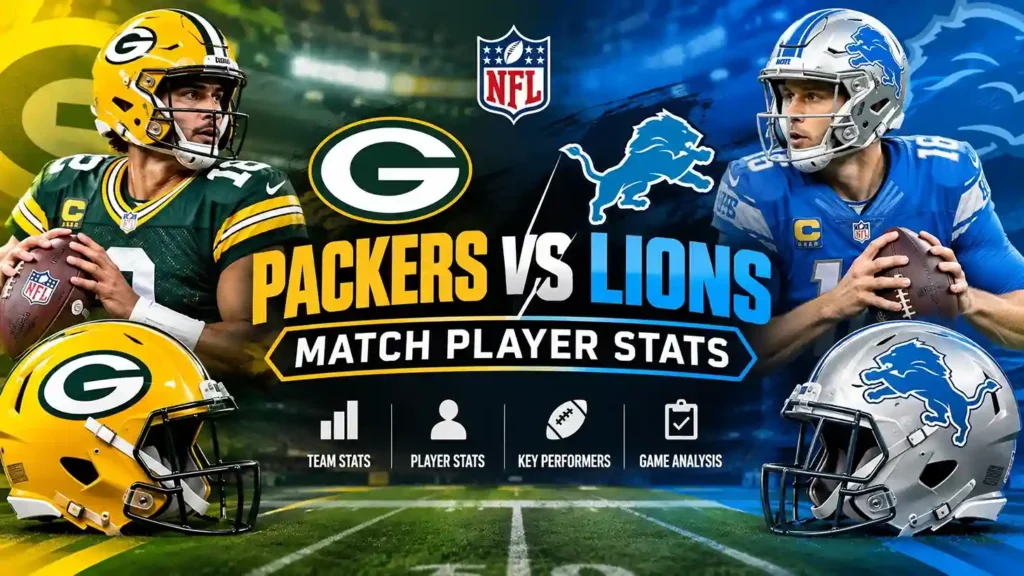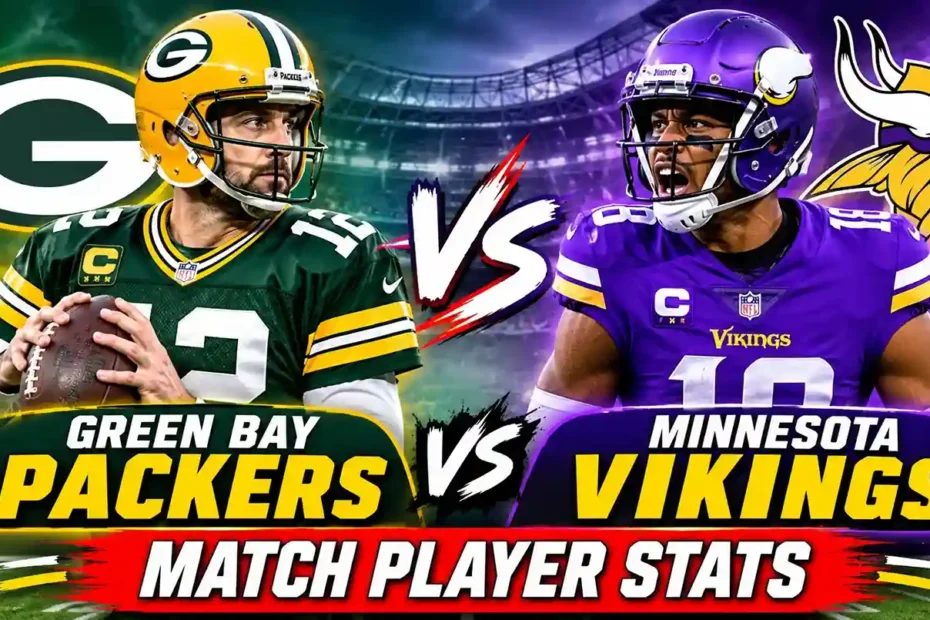
The opening-week Border Battle ended 39-22 in Minnesota’s favor, but the box score tells a stranger story than the scoreboard. Green Bay outgained the Vikings 419 yards to 239, threw for nearly 390 yards, and still lost by 17 points. To understand how that happens, you have to look past team totals and read the individual stat lines.
This guide walks through the green bay packers vs minnesota vikings match player stats from Week 1, adds the freshest injury and form updates from the past few days, and finishes with a head-to-head comparison you can use before the teams meet again at Lambeau Field in Week 10. Every figure comes from official team recaps, ESPN and Fox Sports box scores, or major beat coverage, so you can verify each number yourself.
Green Bay Packers vs Minnesota Vikings Match Player Stats From Week 1
For nearly three quarters, Week 1 at U.S. Bank Stadium looked like Green Bay’s game. The Packers built a 22-10 lead and still held a 22-17 edge early in the fourth quarter. Then the afternoon flipped. Minnesota scored the final 29 points, and the Packers went quiet for the last 20 minutes. Each position group below explains a different piece of that swing.
Quarterbacks: Love’s Volume vs Wentz’s Efficiency
Jordan Love finished 21 of 42 for 387 yards, two touchdowns and one interception, a passer rating of 88.1. His 9.2 yards per attempt look elite, yet a 50 percent completion rate and four sacks stopped too many drives short. Minnesota recorded 15 quarterback hits, and edge rusher Dallas Turner alone accounted for seven of them, according to the Packers’ own game recap.
The Vikings’ quarterback story was stranger. Kyler Murray, making his debut in purple, left in the first quarter with a concussion after a scramble hit that drew a 15-yard unnecessary roughness flag on Packers safety Javon Bullard. He had completed three of five passes for 18 yards with one interception. Veteran Carson Wentz stepped in and went 12 of 19 for 133 yards, three touchdowns, no interceptions and a 123.5 rating.
Notice that Wentz averaged only 7.0 yards per attempt. Minnesota did not win on chunk plays through the air. It won on timing, short-field execution and sustained drives. Third down makes the point cleanly: the Vikings converted 8 of 15, while Green Bay converted just 3 of 12. A quarterback who stays ahead of the sticks will beat a quarterback who posts bigger totals behind them.
Receivers and Tight Ends: Watson Explodes, Jefferson Closes
Christian Watson posted the best receiving line of the day: six catches, 147 yards, two touchdowns and an 81-yard long, all on only eight targets. Matthew Golden led the team with 12 targets and turned them into six receptions for 95 yards. Tucker Kraft added three catches for 65 yards. The odd man out was Jayden Reed, who caught three of seven targets for 20 yards, a reminder that target volume and efficiency are different measurements.
Minnesota’s passing game was narrower and sharper. Justin Jefferson caught eight of nine targets for 92 yards and two touchdowns, covering 39 and 9 yards, and he saw roughly one of every three Vikings pass attempts. T.J. Hockenson added a 16-yard touchdown on four catches for 36 yards, and Josh Oliver chipped in two catches for 22.
Three touchdown passes on just 19 attempts from Wentz is a rate that rarely repeats. Still, it explains how a 132-net-yard passing day produced 39 points.
Ground Game: Committees and Goal-Line Carries
Neither backfield dominated between the twenties. Green Bay’s MarShawn Lloyd carried 13 times for 37 yards, a 2.8 average, and Chris Brooks added 29 yards on seven carries. That left the Packers with only 66 rushing yards as a team. Minnesota’s Jordan Mason led all rushers with 59 yards and a touchdown on 15 carries, including a 28-yard run. Aaron Jones Sr. added 40 yards on 12 carries and a 3-yard score.
The real story was where those carries happened. Jones, who left Green Bay for Minnesota in 2024, scored his touchdown and Wentz found Jefferson for the two-point conversion. Mason followed with a 1-yard score. In total, the Vikings turned all four red-zone trips into touchdowns. The Packers scored touchdowns on only one of four. That gap is the clearest single explanation for the 17-point margin.
Defense, Pressure and Penalties
Minnesota sacked Love four times, with Andrew Van Ginkel credited with 1.5 of the sacks listed on the ESPN box score, and cornerback Byron Murphy Jr. tallied eight tackles. On the other side, Green Bay’s Edgerrin Cooper recorded a sack but the Packers’ defense could not stop the late scoring run.
Discipline decided more than anyone expected. Green Bay was flagged 12 times for 98 yards, compared with three penalties for 15 yards for Minnesota. The Packers also lost the turnover battle, two to one. Add the red-zone gap and the third-down gap, and the 419-239 yardage edge becomes a statistic that flatters the losing team.
Latest Updates Before the Week 10 Rematch
The standings picture has shifted since the opener. Minnesota owns a 6-1 record after suffering its first loss of the season, a 19-15 defeat at Detroit that exposed real offensive problems. Green Bay sits at 5-3 after beating Carolina 27-19 on Thursday night, but still trails the rest of a crowded NFC North.
Packers: Parsons, a Broken Run Game and a Deep Receiver Room
The biggest storyline is Micah Parsons. The star pass rusher tore his ACL and meniscus in December of last year and remains on the physically unable to perform list. Coach Matt LaFleur said the intention is for him to practice this week, and national reporting points to a possible debut around Week 12. Based on that timeline, do not count on Parsons for the Vikings game. In his first Green Bay season he produced 12.5 sacks and a league-high 64 pressures in only 14 games, so his absence still shapes every pass-rush number.
Even without him, the defense has been productive. Fox Sports’ matchup page lists the Packers first in the league in both sacks and interceptions this season, and Green Bay has held five consecutive opponents under 20 points. Yet the team’s four edge rushers combined for only 9.5 sacks entering the Carolina game, which suggests the pressure is coming from creative sources rather than elite individual wins.
The offense is lopsided. Green Bay entered Week 8 with the league’s lowest rushing average, about 60 yards per game. Josh Jacobs returned from a six-week absence against Carolina but managed only 39 yards on 21 carries, though he scored once and caught six passes. Love made up the difference with 288 yards and three touchdowns, while Watson (eight catches, 113 yards) and Golden (seven catches, 79 yards and a touchdown) did the heavy lifting. According to ESPN research, four Packers catching six or more passes in one game has happened only three times in franchise history.
Vikings: Murray’s Hamstring and a Frustrated Star
Minnesota’s quarterback situation remains unsettled. Murray has completed 83 of 125 passes for 812 yards, three touchdowns and two interceptions at last count, modest production for a team with a 6-1 record. He is now undergoing a full evaluation for a sore hamstring, and coach Kevin O’Connell has stated the team remains committed to him as the starter. Wentz is next in line, and J.J. McCarthy served as the emergency quarterback in Week 1.
Jefferson, meanwhile, declined to speak with reporters after the Detroit loss. Murray acknowledged his receiver’s frustration and said it is on the offense to get him the ball. Against the Lions the Vikings punted five times, turned the ball over on downs once, and watched Murray overthrow Jefferson on an interception. That context matters when you project the star receiver’s numbers for the rematch.
Head-to-Head Comparison: Packers vs Vikings Player Stats
Tables are the fastest way to see where each team really won or lost. The first one compares the key Week 1 lines side by side. The second zooms out to the last five meetings in the series.
Green Bay Packers vs Minnesota Vikings Match Player Stats Table (Week 1)
| Category | Packers | Vikings | Edge |
|---|---|---|---|
| Final score | 22 | 39 | Vikings |
| Total yards | 419 | 239 | Packers |
| Primary QB line | Love: 21/42, 387 yds, 2 TD, 1 INT | Wentz: 12/19, 133 yds, 3 TD, 0 INT | Vikings (efficiency) |
| Passer rating | 88.1 | 123.5 | Vikings |
| Rushing yards | 66 | 107 | Vikings |
| Top rusher | Lloyd: 13 for 37 | Mason: 15 for 59, 1 TD | Vikings |
| Top receiver | Watson: 6-147, 2 TD | Jefferson: 8-92, 2 TD | Packers (yards), Vikings (catch rate) |
| Third-down conversions | 3 of 12 | 8 of 15 | Vikings |
| Red-zone touchdowns | 1 of 4 | 4 of 4 | Vikings |
| Penalties | 12 for 98 yards | 3 for 15 yards | Vikings |
| Turnovers | 2 | 1 | Vikings |
| Sacks taken | 4 | 3 | Vikings |
The pattern is consistent. Green Bay won the yardage battle and the raw receiving battle, but Minnesota won nearly every situational category that converts yards into points.
Series Snapshot: The Last Five Meetings
| Meeting | Location | Result | Winner |
|---|---|---|---|
| 2024, first game | Green Bay | 31-29 | Vikings |
| 2024, second game | Minneapolis | 27-25 | Vikings |
| 2025, first game | Green Bay | 23-6 | Packers |
| 2025, second game (Week 18) | Minneapolis | 16-3 | Vikings |
| 2026, Week 1 | Minneapolis | 39-22 | Vikings |
Minnesota has won four of the last five, and the Week 18 meeting last season is a useful reference for the receivers. Jefferson caught eight passes for 101 yards that day to reach the 1,000-yard mark, in a game the Vikings won 16-3. Overall, Green Bay still leads the all-time series 67-62-3, counting one win apiece in the two playoff meetings.
Key Player Matchups to Watch at Lambeau Field
The Week 10 rematch shifts from the indoor surface in Minneapolis to the outdoor conditions at Lambeau Field. That change tends to influence passing efficiency and kicking, so keep an eye on how the game plan adapts. These are the individual battles most likely to decide it.
Love against the Vikings’ pass rush. Fifteen quarterback hits in Week 1 is a number Green Bay’s offensive line has to cut dramatically. If Turner and Van Ginkel again collapse the pocket on third down, Love’s strong yards per attempt will not matter.
Watson and Golden against Minnesota’s secondary. Watson’s 81-yard catch showed what the Packers can do when a deep shot gets one-on-one coverage. Golden’s 12 targets show he is the trusted volume option. Together they give Green Bay the best receiving duo in this matchup.
Jefferson against Green Bay’s cornerbacks. Before this season, Jefferson’s career average against the Packers was 87.0 receiving yards per game and 2.47 yards per route run, slightly below his overall career marks of 95.6 and 2.57. Green Bay has been one of the few defenses to keep him slightly contained. His Week 1 line was strong, but a frustrated Jefferson may also draw even more attention.
The Packers’ rushing attack against Minnesota’s front. Green Bay’s run game is the weakest in the league, and Minnesota held the Packers to 66 rushing yards in Week 1. If Jacobs and the backfield cannot move the chains, Love will again face long third downs.
The quarterback question in Minnesota. If Murray plays, expect a more mobile but less proven offense. If Wentz starts, remember that his Week 1 line came in relief, with an offense that was already clicking at the goal line. Either way, the sample size is small.
Final Take on Packers vs Vikings Match Player Stats
The Week 1 numbers show a classic case of volume against efficiency. Love, Watson and Golden produced the more impressive raw totals, while Wentz, Jefferson, Mason and Jones produced the more valuable ones. Third-down conversions, red-zone touchdowns and penalties explain the 17-point margin better than yards, completions or time of possession ever could.
Heading into Week 10, three numbers deserve your attention. First, Green Bay’s third-down rate, which has to climb well above 25 percent. Second, the red-zone touchdown rate for both teams. Third, penalties, since a 12-flag afternoon is nearly impossible to survive against a divisional opponent. Add the uncertainty around Parsons and Murray’s hamstring, and this rematch could look very different from the opener.
Check back after the teams meet again at Lambeau Field. The player lines will shift, the narratives will change, and the numbers that matter most will probably be the ones that do not make the highlight reel.