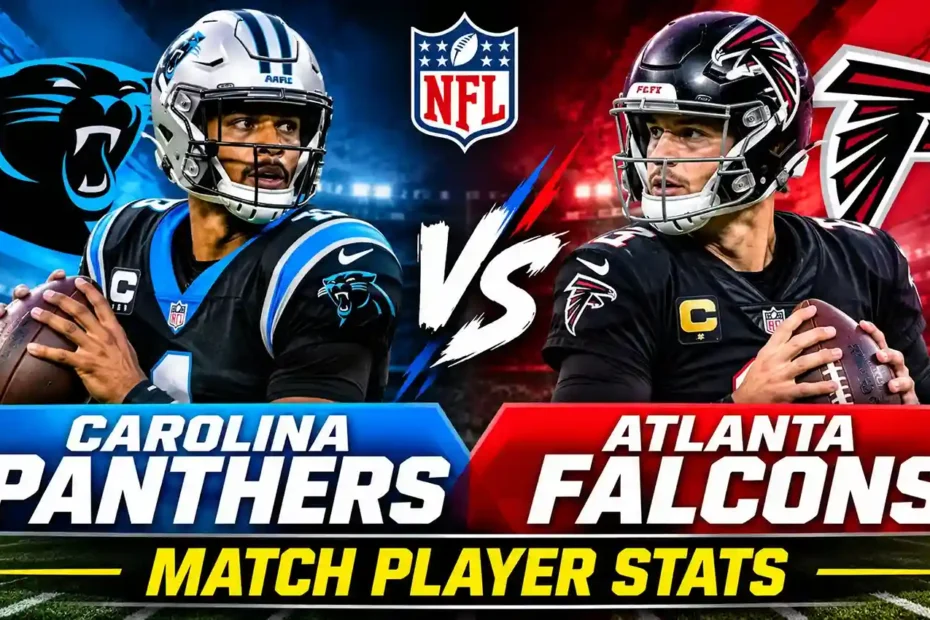
Ask fans what they remember from a Panthers-Falcons game and you will hear about a handful of plays: a pick-six, a long sideline catch, a Bijan Robinson run that simply would not end. The scoreboard keeps those moments alive, but it rarely explains why one team won.
The explanation sits in the box score. Efficiency splits, pressure rates and turnover swings show which side controlled the game and which players shaped it without ever making a highlight reel.
This guide walks through every Carolina Panthers vs Atlanta Falcons match player stat worth your attention: quarterback efficiency, rushing production, receiving matchups, defensive impact and the special-teams details that tilt tight NFC South games. It also folds in the freshest 2026 numbers, including Carolina’s 34-3 Week 2 win and everything that has changed for both teams since.
Latest Updates: Carolina Panthers vs Atlanta Falcons Match Player Stats in 2026
Before diving into the deeper numbers, here is what is new and what matters most heading into the next meeting.
- Week 2 result: Carolina routed Atlanta 34-3 at Mercedes-Benz Stadium. Bryce Young completed 23 of 36 passes for 287 yards and three touchdowns with no interceptions. Linebacker Devin Lloyd answered with nine tackles, a sack, three pass breakups and two interceptions, one of them returned for a touchdown.
- Series standing: Atlanta still leads the all-time series 37-26, yet the Panthers have now won four straight meetings.
- Quarterback shake-up in Atlanta: Kirk Cousins is no longer part of the Falcons’ quarterback room. Cooper Rush started Week 2 while Michael Penix Jr. finished his ACL recovery, and Penix has been the starter ever since.
- New Falcons leadership: Kevin Stefanski is the head coach, with Tommy Rees running the offense.
- Carolina’s defensive change: The Panthers parted ways with defensive coordinator Ejiro Evero and handed play-calling to Todd Wash on an interim basis for the final ten games.
- Division race: Both teams sit at 3-4, with Tampa Bay and New Orleans one game back at 2-5.
- Recent form: Young threw for 209 yards but absorbed six sacks in a 27-19 loss at Green Bay. Penix, meanwhile, earned NFC Offensive Player of the Week honors after three touchdown passes in a 29-20 win over San Francisco.
- What is next: The Week 18 rematch is set for Bank of America Stadium on the weekend of Jan. 9-10, 2027.
Why This NFC South Rivalry Produces Wildly Uneven Player Performances
The two clubs have met 63 times since Carolina joined the league in 1995, and Carolina’s very first game was an overtime loss in Atlanta. With that much history you would expect the numbers to level out. They do not.
Atlanta owns the long-term edge, but the recent trend points the other way. Across the last five meetings Carolina is 4-1 and has outscored Atlanta 158-106. That run includes a 44-38 overtime thriller, a 30-0 shutout, a 30-27 overtime finish in which Young set a franchise record with 448 passing yards, and this season’s 34-3 result. The last of those matches the 34-3 score Carolina posted in Atlanta back in 2014.
Scores that swing from shutouts to shootouts produce player lines that swing just as wildly.
Geography adds a twist too. Atlanta and Charlotte sit about four hours apart on Interstate 85, so both fan bases fill the visiting sections and blunt crowd-noise advantages.
Finally, these teams meet twice a year, so the second game rarely looks like the first. Atlanta will arrive in Charlotte for the Week 18 rematch with a healthier quarterback room and a full film study of how Carolina won, and Carolina will be playing for a new defensive coordinator.
Quarterback Showdown: Bryce Young vs Michael Penix Jr. Head-to-Head Stats
Quarterback play shapes almost everything in this rivalry. Young, the first overall pick in 2023, has matured into a high-volume passer who attacks downfield and keeps plays alive. Penix, drafted eighth overall in 2024, is a rhythm thrower returning from a third knee reconstruction who has steadied Atlanta’s offense since coming back.
One wrinkle matters for the 2026 head-to-head. Penix missed the first two games, so Week 2 was really Young against Cooper Rush. The season-long comparison, however, pits Young against Penix, and the two profiles contrast sharply.
Passing Yards, Completion Rates, and Downfield Accuracy
Week 2 showed the gap in its starkest form. Young finished at roughly 64 percent completions and about eight yards per attempt, with an average intended depth near 8.6 yards on each throw. Twelve of his completions moved the chains. Atlanta’s passers, by comparison, managed only 145 yards on 32 attempts, or about 4.5 yards per try. Rush completed 10 of 17 for 86 yards, and rookie Jack Strand went 8 of 15 for 59.
Atlanta pressured Young on roughly one-third of his dropbacks and sent extra rushers nine times, yet he still produced 287 yards because his receivers won downfield.
Across the season, Young has 1,921 passing yards, 13 touchdowns and five interceptions through seven games, good for a passer rating near 89 and roughly 274 yards per game. Penix’s career line after 17 starts reads 61.5 percent completions, 3,914 yards, 21 touchdowns and seven interceptions. This year he ranks ninth in ESPN’s QBR at 67.1 and 13th in EPA per dropback.
The team-level effect is even clearer. Atlanta scored just 16 points in its first two games without Penix, then averaged 34.3 over the next three with him.
Turnover Differential and Clutch-Quarter Performance
Turnovers decided Week 2. Rush threw two interceptions, fumbled once and was pulled in the third quarter with a passer rating of 32.6. Young’s rating was 116.3. Carolina intercepted three passes in total, and that swing alone explains most of a 31-point margin.
Pressure can flip the script. Young’s two weakest recent outings brought two interceptions and a fumble-six against Tampa Bay, then six sacks and 5.1 yards per attempt in Green Bay. Protection is Carolina’s swing variable.
Penix has shown the opposite late-game temperament. Against San Francisco he trailed 14-3, then delivered touchdowns to Drake London, Kyle Pitts and Nick Muse to flip the game. Atlanta’s offensive coordinator called him unflappable, and a first NFC Offensive Player of the Week award followed.
Rushing Attack Breakdown: Who Dominates the Ground Game?
Both offenses want to run, but game script decides how often. Carolina led comfortably in Week 2, while Atlanta fell behind early and had to lean on a struggling passer.
Carolina’s backfield numbers were modest: Chuba Hubbard carried 12 times for 53 yards, Jonathon Brooks added 16 yards on five attempts, and AJ Dillon lost three yards on three carries. Efficient passing did the heavy lifting.
Chuba Hubbard vs Bijan Robinson: A Tale of Two Running Backs
Bijan Robinson is the most productive back in this matchup by a wide margin. Through seven games he leads the NFL with 704 rushing yards on a 5.4-yard average with four touchdowns, and he has added 25 catches for 203 yards. His 194-yard rushing game against Green Bay, part of a 213-yard scrimmage night, was a career-defining performance.
Against Carolina in Week 2, though, he was limited to 81 scrimmage yards on 20 touches. That fits a pattern: Robinson’s best games come when Atlanta is leading and can feed him in the second half.
Hubbard also contributes as a receiver. He caught a touchdown in Week 2 on top of his 53 rushing yards, production that traditional rushing totals ignore.
Here is the real storyline for the rematch. Carolina’s defense ranks third-worst in the league against the run, and Tampa Bay piled up 258 rushing yards on it in Week 7. If that does not improve under Wash, Robinson could dominate the Week 18 game.
Receiving Corps and Tight End Matchup Stats That Shift Momentum
Wide receiver production in this rivalry runs hot and cold, which makes weekly projections tricky.
In Week 2 Carolina’s passing game spread the ball around: Tetairoa McMillan caught five passes for 101 yards on ten targets, Jalen Coker hauled in eight for 66, and Xavier Legette stretched the field with a 55-yard reception. Tight end Darren Waller added two touchdowns on only three catches.
Atlanta’s offense flows through London, who managed four catches for 51 yards.
Drake London and Kyle Pitts vs the Panthers Secondary
London’s season is a tale of two stretches. After modest lines in the first two games, he exploded once Penix returned, with 194 yards against Green Bay, 96 against New Orleans and 118 against Baltimore. Pitts, who made only one catch in Week 2, has scored four touchdowns in the five games since Penix took over.
The matchup problem for Carolina is depth at cornerback. Starters Jaycee Horn and Mike Jackson have been on injured reserve, forcing rookie Will Lee III and practice-squad elevation Marco Wilson into the lineup in Week 8. If Horn and Jackson are cleared, the secondary improves overnight, but a thin group can leave London and Pitts exposed in a Week 18 rematch.
Rookie safety Zakee Wheatley did intercept his first pro pass in Week 8.
Defensive Player Stats That Decide the Outcome
Defense is where the Carolina Panthers vs Atlanta Falcons match player stats get genuinely interesting, because the two units are built differently and are trending in opposite directions.
Atlanta leans on pressure and disguise. Carolina leans on its front seven but ranks 23rd overall this season, 30th in scoring defense during Evero’s tenure and last against the run. Replacing him with Wash, a veteran line coach who once coordinated Jacksonville’s top-ranked unit, is a clear attempt to unlock the talent already on the roster.
Pass Rush and Sack Leaders on Both Sides
Atlanta did not dominate the passing downs in Week 2. The Falcons sacked Young twice, hurried him seven times and hit him four times, for 13 total pressures. That volume looks good on paper, but Young escaped often enough to hit explosive plays.
Carolina’s pass rush was far more productive. It sacked Atlanta’s quarterbacks three times, including twice on Strand, and pressured him on nearly 37 percent of his dropbacks. Interior linemen Derrick Brown, Bobby Brown III and Tershawn Wharton anchor the group, and edge rusher Jaelan Phillips, who missed two games with a hamstring injury, should return to boost it.
Secondary Interceptions and Pass Deflections
Lloyd was the star of Week 2, pairing two interceptions with three pass deflections and scoring on one of the picks. Carolina took the ball away three times overall.
Safety Jessie Bates III leads Atlanta’s secondary, but the Falcons did not intercept Young in Week 2, and he has thrown only five picks all year.
Special Teams and Hidden Stats Most Fans Completely Overlook
Special teams rarely appear on highlight reels, yet they quietly swing close rivalry games. Both the 2024 and 2025 series produced overtime games, and each of those finished with margins of six points or fewer, which is exactly where a missed field goal or a short punt can decide the result.
Week 2 did not hinge on special teams, since Atlanta’s only points came from a field goal. Trend metrics tell you more than single-game totals.
Three numbers deserve attention in the rematch. The first is net punting average, which determines how long the field is for each offense. The second is starting field position after kickoffs, which affects Young’s drives more than most fans realize because Carolina often plays from behind. The third is accuracy on field goals between 40 and 49 yards, the range where most close divisional games are settled.
Carolina Panthers vs Atlanta Falcons Match Player Stats Comparison Table
The table below puts the most important Week 2 numbers and 2026 season markers side by side so you can scan the gap quickly.
| Stat Category | Panthers Key Player | Panthers Number | Falcons Key Player | Falcons Number |
|---|---|---|---|---|
| Passing line (Week 2) | Bryce Young | 23/36, 287 yds, 3 TD, 0 INT | Cooper Rush | 10/17, 86 yds, 0 TD, 2 INT |
| Season quarterback marker | Bryce Young | 1,921 yds, 13 TD, 5 INT | Michael Penix Jr. | 67.1 QBR (9th in NFL) |
| Rushing (Week 2) | Chuba Hubbard | 12 carries, 53 yds | Bijan Robinson | 81 scrimmage yds on 20 touches |
| Season rushing | Panthers backfield | Third-worst run defense in the NFL | Bijan Robinson | 704 yds, 5.4 per carry, 4 TD |
| Top receiver (Week 2) | Tetairoa McMillan | 5 catches, 101 yds | Drake London | 4 catches, 51 yds |
| Tight end (Week 2) | Darren Waller | 3 catches, 33 yds, 2 TD | Kyle Pitts | 1 catch, 15 yds |
| Sacks (Week 2) | Team total | 3 | Team total | 2 |
| Interceptions (Week 2) | Devin Lloyd | 2 (one returned for a TD) | Jessie Bates III | None recorded |
The table makes the story clear. Carolina won Week 2 through quarterback efficiency, receiver production and takeaways, while Atlanta’s best advantages live in its running game and its healthier quarterback situation.
Head-to-Head Record and Recent Results
| Season | Result at Atlanta | Result at Carolina |
|---|---|---|
| 2024 | Panthers 44, Falcons 38 (OT) | Falcons 38, Panthers 20 |
| 2025 | Panthers 30, Falcons 27 (OT) | Panthers 30, Falcons 0 |
| 2026 | Panthers 34, Falcons 3 | Week 18, to be played |
Atlanta leads the series 37-26, while Carolina has won four meetings in a row. In the five most recent games, Carolina has outscored Atlanta by 52 points.
To extend the streak, Carolina must keep Young upright and slow Robinson. To snap it, Atlanta needs Penix to attack a thin secondary and the game to stay close.
The Final Word on Carolina Panthers vs Atlanta Falcons Match Player Stats
The numbers describe a rivalry that is far more balanced than the all-time record suggests. Atlanta has the better running back, a quarterback who is trending upward and a lopsided history, but Carolina has won four straight and has the more explosive passing game.
When you watch the Week 18 rematch, look past the box-score totals and focus on three things: how often Young gets sacked, whether Carolina’s run defense improves under Wash, and how Penix performs when he is pressured. Those three indicators will usually reveal who is winning the tactical battle long before the final score arrives.
In a divisional race this tight, the smallest statistical edge is often the one that decides it.