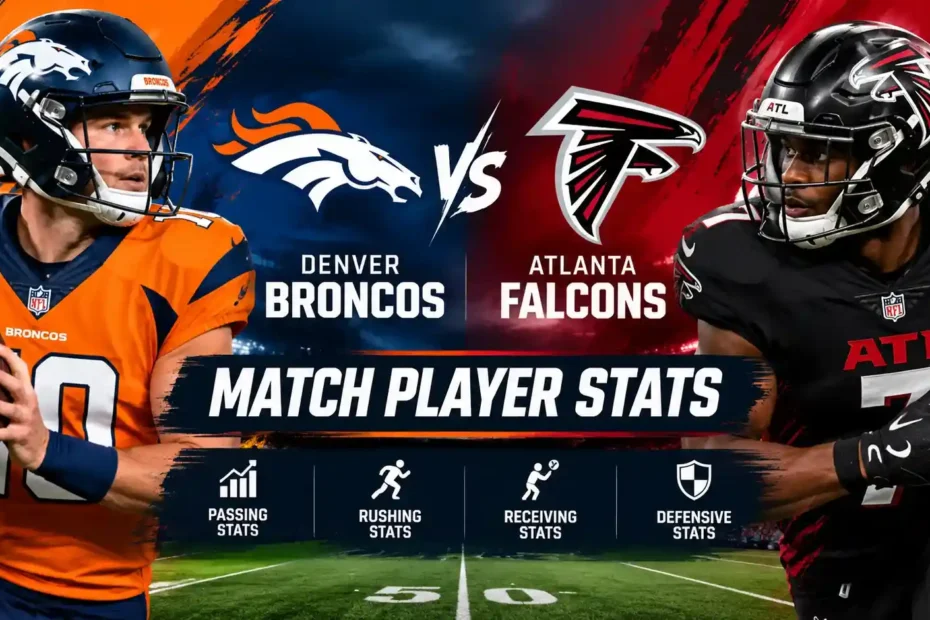
Most fans assume they know how an AFC West team plays out against an NFC South opponent. The box scores say otherwise. Some of the biggest swings in this series came from places nobody was watching: a Hall of Fame quarterback throwing three interceptions, a rookie passer posting a 145.0 rating, and a running back who quietly dragged a defense into the fourth quarter.
The Denver Broncos vs Atlanta Falcons match player stats from 2012, 2016, 2020 and 2024 show four very different games. Each one flipped the story the pre-game coverage had written. Fantasy managers who trusted reputation over matchup data learned that lesson the hard way.
This guide walks through the passing, rushing, receiving, defensive and special teams numbers that defined the series. It also adds a head-to-head comparison and the latest updates on both franchises, so you can see how the old numbers connect to the 2026 season.
A Brief History of the Broncos vs Falcons Rivalry
Denver and Atlanta sit in different conferences, so they meet only once every few years under the NFL’s rotating schedule. That scarcity gives every meeting extra weight. It also means the sample is small enough that a single huge performance can reshape the all-time narrative.
The modern run started on a Monday night in 2012 at the Georgia Dome. Peyton Manning arrived in Atlanta in his first season with Denver, and Matt Ryan’s offense was in its prime. The Falcons won 27-21 and moved to 2-0, despite Denver scoring twice in the fourth quarter to make it close.
Four years later, Atlanta traveled to Denver as the Broncos defended their Super Bowl 50 title. The Falcons won again, 23-16, with a balanced attack that leaned on the run and a few explosive passing plays. Denver started Paxton Lynch that day, and the offense struggled to protect him.
The 2020 game moved back to Atlanta. The Falcons built a 27-6 lead through three quarters and held on for a 34-27 win after Denver scored three fourth-quarter touchdowns. That made it three straight wins for Atlanta in the series.
Then came 2024, and the pattern broke. Denver hosted the Falcons and won 38-6, the Broncos’ first home win over Atlanta since September 2000. Those four games are why the Denver Broncos vs Atlanta Falcons match player stats are worth studying: the era, the quarterback and the game plan changed each time, and so did the numbers.
Quarterback Showdown: Passing Stats That Tell the Real Story
No position drives more debate in this series. Both teams have spent heavily on quarterbacks, and the head-to-head passing lines reflect it. Denver has started Peyton Manning, Paxton Lynch, Drew Lock and Bo Nix against Atlanta. The Falcons answered with Matt Ryan three times, then Kirk Cousins, with Michael Penix Jr. appearing in garbage time in 2024.
The pattern is clear in the data. Ryan posted a passer rating of 98.4 or better in all three of his starts against Denver. The Broncos quarterback with the best game, Bo Nix, did it at home against a defense that never found a rhythm.
Peyton Manning’s Rough Night in Atlanta
Manning’s 2012 game is the one that surprises people most. He completed 24 of 37 passes for 241 yards and a touchdown, but he also threw three interceptions and was sacked three times, finishing with a 58.5 rating. It was not the clean, surgical performance the legend suggests.
What saved the scoreboard was the ground game. Willis McGahee ran 22 times for 113 yards and two fourth-quarter touchdowns, which kept the final margin to six points. Manning’s raw yardage looked fine; his turnover count is what decided the night.
Matt Ryan’s Efficiency Against Denver
Ryan was the steadier quarterback in the series. In 2012 he completed 24 of 36 for 219 yards and two touchdowns without an interception, a 101.5 rating. He spread the ball across Roddy White, Tony Gonzalez, Julio Jones and Harry Douglas, and he was sacked only once.
His 2016 game in Denver was even more telling. Ryan completed just 15 of 28 passes, but he gained 267 yards and a touchdown, and he did not throw an interception. Those 9.5 yards per attempt came on big plays, including a 49-yard connection with Tevin Coleman. Denver sacked him twice, yet he kept finding the open man downfield.
In 2020 Ryan completed 25 of 35 for 284 yards and three touchdowns, with one interception. That included a 51-yard score to Olamide Zaccheaus and a 21-yard touchdown to Julio Jones, and it finished with a 112.1 rating. Across three games, Ryan threw six touchdowns to three interceptions against Denver, a quiet but consistent edge.
Running Back Battles: Rushing Yards and Touchdown Breakdowns
The 2016 game is the clearest example. Devonta Freeman carried 23 times for 88 yards and a touchdown, and Coleman added 31 yards on six carries. Together they gave Atlanta roughly 120 yards on the ground, which kept the clock moving and kept Denver’s pass rush from pinning its ears back.
Key Ground Game Performances
Willis McGahee’s 113-yard, two-touchdown effort in 2012 is the best individual rushing line by a Broncos back in this stretch. Knowshon Moreno was a minor factor that night, with three carries for two yards. Michael Turner ran 17 times for 42 yards and a short touchdown for Atlanta, a modest total with a large effect in the red zone.
The 2020 game was a grind. Todd Gurley carried 19 times for 53 yards and the clinching-style touchdown, and the Falcons totaled 92 rushing yards on 32 attempts. Denver countered with quarterback Drew Lock, who ran for 47 yards and a touchdown. In 2024 Javonte Williams scored on a 14-yard run and finished with 59 yards on nine carries, while Bijan Robinson was held to 35 yards on twelve.
Wide Receiver and Tight End Matchup Stats
The skill-position battles in this series have been uneven in the best way. Both teams have featured receivers who could turn a modest game plan into a big night. What changes is how each team used them.
Atlanta’s Pass Catchers Against Denver
Roddy White had the best receiving game for Atlanta in 2012, catching eight passes for 102 yards and a touchdown. Gonzalez added seven catches for 70 yards and a score, which shows how much the Falcons trusted their veterans in the red zone.
The 2016 game belonged to Coleman as a receiver. He caught four passes for 132 yards and a touchdown, with a long of 49 yards. Julio Jones was held to two catches for 29 yards, but the attention he drew opened space for everyone else. Mohamed Sanu added three catches for 43 yards.
In 2020, Zaccheaus had four catches for 103 yards and a touchdown, and Hayden Hurst caught seven passes for 62. Jones finished with five catches for 54 yards and a score.
Denver’s Receivers Against Atlanta
Demaryius Thomas was the most consistent Denver target. In 2012 he led all receivers with eight catches for 78 yards and a touchdown on eleven targets, and Eric Decker added four catches for 53 yards. In 2016 Thomas scored again with five catches for 49 yards, while Emmanuel Sanders led the team with seven catches for 80 yards.
Jerry Jeudy had the standout day in 2020, with seven receptions for 125 yards and a touchdown, and K.J. Hamler added six catches for 75. In 2024 the offense spread the wealth: Courtland Sutton had seven catches for 78 yards, Devaughn Vele four for 66, Lil’Jordan Humphrey scored on a 41-yard catch, and Marvin Mims added a 12-yard touchdown. Four different receivers scored for Nix.
Defensive Player Stats: Sacks, Interceptions, and Turnovers
Defensive production decided the biggest games in this series, but the leaders changed with each era. Pressure, not sack totals alone, was the common thread.
In 2012 the turnover count did the damage to Denver. Manning’s three interceptions gave Atlanta a short field several times, and Denver’s defense had to answer constantly. In 2016 Paxton Lynch was sacked six times, which stalled drive after drive and kept the Broncos’ offense behind schedule even though the score stayed close until the final minutes.
The 2020 game produced two sacks for Denver, from Dre’Mont Jones and DeMarcus Walker, and one for Atlanta from Foye Oluokun, who also led the Falcons with ten tackles and four quarterback hits. Justin Simmons intercepted a pass for Denver, and Atlanta’s Ricardo Allen picked one off as well.
The best defensive performance came in 2024. Denver sacked Cousins four times: Nik Bonitto had two, with Jonah Elliss and Malcolm Roach adding one each. Cody Barton intercepted a pass, and Atlanta managed only 226 net yards against Denver’s 400. Matt Judon had the Falcons’ lone sack, and Kaden Elliss and Jessie Bates each made ten tackles in a losing effort.
Special Teams and Kicking Game Numbers
Special teams rarely headline the recap, but the kicking numbers explain the margins in two of these games.
The 2020 punting battle favored Denver. Sam Martin averaged 45.0 yards on five punts with a long of 64, and four landed inside the 20. Atlanta’s Sterling Hofrichter averaged 36.6. Younghoe Koo made field goals from 52 and 35 yards.
In 2024 the roles reversed. Koo made kicks of 41 and 51 yards, but those were Atlanta’s only points. Marvin Mims averaged 19.0 yards on three punt returns with a long of 37, and Wil Lutz added a 45-yard field goal. It was a day when Denver won the hidden-yardage battle.
Head-to-Head Player Stats Comparison Table
This table collects the best individual lines from each of the four recent meetings. It gives you a quick read on which players stepped up when the stakes were highest.
| Player | Team | Year | Position | Yards | TDs | Key Stat |
|---|---|---|---|---|---|---|
| Peyton Manning | Broncos | 2012 | QB | 241 passing | 1 | 3 INTs, 3 sacks |
| Matt Ryan | Falcons | 2012 | QB | 219 passing | 2 | 0 INTs |
| Willis McGahee | Broncos | 2012 | RB | 113 rushing | 2 | 22 carries |
| Roddy White | Falcons | 2012 | WR | 102 receiving | 1 | 8 catches |
| Matt Ryan | Falcons | 2016 | QB | 267 passing | 1 | 0 INTs |
| Devonta Freeman | Falcons | 2016 | RB | 88 rushing | 1 | 23 carries |
| Tevin Coleman | Falcons | 2016 | RB | 132 receiving | 1 | 49-yard long |
| Matt Ryan | Falcons | 2020 | QB | 284 passing | 3 | 112.1 rating |
| Jerry Jeudy | Broncos | 2020 | WR | 125 receiving | 1 | 7 catches |
| Bo Nix | Broncos | 2024 | QB | 307 passing | 4 | 145.0 rating |
| Javonte Williams | Broncos | 2024 | RB | 59 rushing | 1 | 14-yard TD |
| Nik Bonitto | Broncos | 2024 | LB | N/A | 0 | 2 sacks |
Head-to-Head Team Comparison by Meeting
| Season | Site | Final Score | Winning QB Line | Losing QB Line |
|---|---|---|---|---|
| 2012 | Atlanta | Falcons 27, Broncos 21 | Ryan: 24/36, 219 yds, 2 TD, 0 INT | Manning: 24/37, 241 yds, 1 TD, 3 INT |
| 2016 | Denver | Falcons 23, Broncos 16 | Ryan: 15/28, 267 yds, 1 TD, 0 INT | Lynch: 23/35, 223 yds, 1 TD, 1 INT |
| 2020 | Atlanta | Falcons 34, Broncos 27 | Ryan: 25/35, 284 yds, 3 TD, 1 INT | Lock: 25/48, 313 yds, 2 TD, 1 INT |
| 2024 | Denver | Broncos 38, Falcons 6 | Nix: 28/33, 307 yds, 4 TD, 0 INT | Cousins: 18/27, 173 yds, 0 TD, 1 INT |
Across these four games the Falcons lead 3-1, and what mattered most was how many drives each offense could finish without a mistake. Ball security plus pressure on the opposing passer decided three of them.
What These Stats Mean for Future Matchups
The historical Denver Broncos vs Atlanta Falcons match player stats offer a useful framework for future meetings, even though rosters and coaches have changed completely.
Quarterback decision-making remains the largest variable. In every game above, the quarterback with fewer turnovers and more explosive completions won or came very close. Denver’s ability to protect Nix in 2024 shows how much a clean pocket can change the result.
Pass pressure without extra rushers is the other swing factor. Denver’s front harassed Cousins in 2024 with four sacks, and Atlanta’s best defensive days came when edge defenders forced hurried throws. The team that creates pressure from its front four can drop more players into coverage and take away big plays.
Finally, third down is a reliable indicator. In 2024 Denver converted six of eleven third-down attempts, while Atlanta managed four of thirteen. That gap, more than raw yardage, is a dependable signal of who will control a game.
Latest Updates on the Broncos vs Falcons Series
Next meeting. The 2024 game was the most recent regular-season meeting. Under the NFL’s rotation, the next one is not expected until later this decade, and the league confirms matchups each spring. A 2026 preseason game between the teams took place in Atlanta, but exhibition stats do not count toward the series.
Bo Nix and the Broncos. Nix’s 2024 breakout set the tone for Denver’s rise, but an ankle injury ended his 2025 season in the divisional round after a win over Buffalo, and he needed surgery. He returned during the 2026 preseason and has faced heavy criticism during a slow start to the season, though the Broncos have publicly stood by him. Extension talk remains part of the conversation around the franchise.
Falcons reset. Atlanta hired Kevin Stefanski as head coach and Ian Cunningham as general manager after the 2025 season, with Matt Ryan returning as president of football. That adds a nice twist to this series, since Ryan produced the most reliable passing lines against Denver. Michael Penix Jr. missed the first two games of 2026 and returned for a win in which Bijan Robinson ran for 194 yards and two touchdowns.
Final Thoughts on This Cross-Conference Clash
The Denver Broncos vs Atlanta Falcons match player stats show a series defined by small edges, not big names. Ball security, pressure and efficiency decided every game, and the star quarterback did not always win the box score.
If you take one lesson from these numbers, make it this: turnovers and third-down success tell the story better than total yards. Manning’s three interceptions, Ryan’s zero-turnover games and Nix’s perfect 2024 afternoon all prove it.