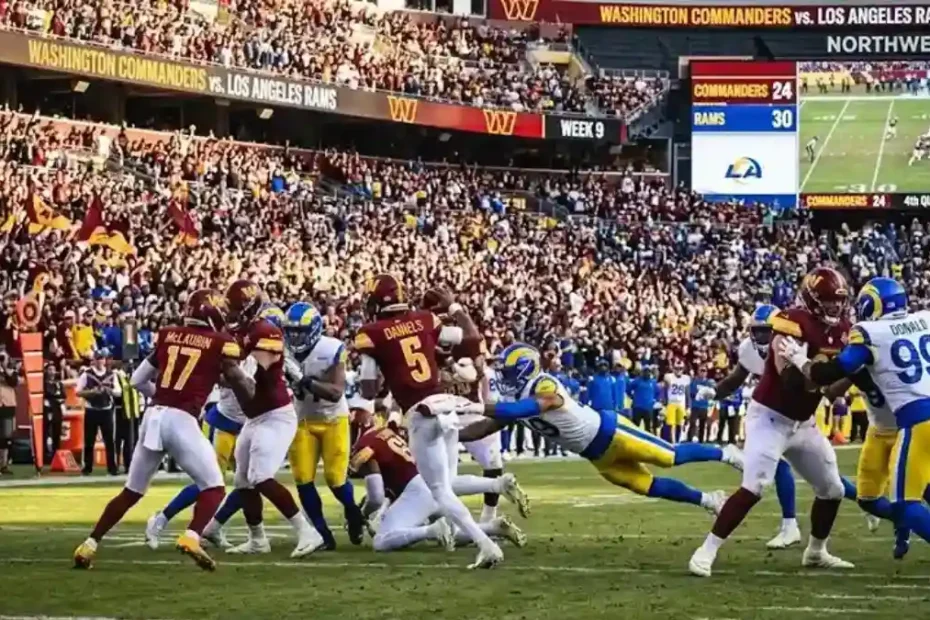
TL;DR: The Washington Commanders vs Los Angeles Rams match player stats reveal a clash of contrasting styles. Matthew Stafford’s 2,146 passing yards and 15 touchdowns power a high-volume Rams offense, while Jayden Daniels’ 97.6 passer rating and zero interceptions headline a Commanders attack that protects the football. The head-to-head comparison shows Los Angeles owns the edge in total yards and passing efficiency, but Washington’s ninth-ranked rushing attack and a defense featuring Odafe Oweh (4 sacks) could flip the script. Below, every key number from the 2026 season is broken down to show exactly where this game will be won and lost.
Why This NFC Clash Had Everyone Glued to Their Screens in 2026
The Washington Commanders walked into the 2026 season carrying a level of energy that almost nobody predicted. A dynamic second-year quarterback in Jayden Daniels, a revamped receiving corps featuring Stefon Diggs, and a defensive front finally generating consistent pressure have turned Washington into a competitive force in the NFC East.
Across the field, the Los Angeles Rams brought their trademark offensive firepower and a defensive unit that ranks fifth in the league, allowing just 301.1 yards per game. Matthew Stafford, even in the later stages of his career, remains one of the most efficient quarterbacks in football, and the emergence of Puka Nacua as a true No. 1 receiver has kept the Rams’ passing game among the NFL’s elite.
What makes this particular Washington Commanders vs Los Angeles Rams match player stats breakdown so compelling is the sharp contrast in offensive philosophy. One team (Los Angeles) chases explosive chunk plays through a high-volume passing attack, while the other (Washington) surgically dismantles coverage with timing-based precision routes and a commitment to the run. The numbers below expose exactly how each approach has played out and which strategy has carried more weight when the game hangs in the balance.
Quarterback Showdown: Jayden Daniels vs Matthew Stafford
No honest breakdown of this game makes any sense without starting under center. Both quarterbacks have posted numbers that demand serious attention in 2026, even though they have reached those totals through wildly different methods.
Jayden Daniels’ Performance Under Pressure
Daniels has displayed the kind of calm pocket presence that typically takes young signal-callers two or three full seasons to develop. Through his first four games of the 2026 campaign, he completed 75 of 116 passes for 759 yards, five touchdowns, and zero interceptions, posting a 97.6 passer rating.
His yards per attempt hover around 6.5, which tells you he is taking calculated shots rather than dumping the ball off on every obvious passing down. That aggression has kept multiple drives alive when the offense desperately needed a spark. He also uses his legs to scramble for meaningful yardage; he has already rushed for 236 yards and multiple scores, turning potential punts into fresh sets of downs.
One stat that jumps off the page is his zero-interception performance despite facing blitz packages on a significant portion of his dropbacks. That level of decision-making under heavy duress is genuinely rare for a first-year starter in this league. For a Washington Commanders vs Los Angeles Rams match player stats comparison, Daniels’ ball security is the defining variable.
Matthew Stafford’s Veteran Command
Stafford has thrown for 2,146 yards with 15 touchdowns and 8 interceptions through the 2026 season, distributing the football to a deep rotation of receivers with the kind of accuracy that only comes from years of reading complex coverages at full speed.
His completion percentage sits comfortably above 63 percent, and his touchdown-to-interception ratio remains among the league’s best. The most underrated Stafford stat from this matchup might be his third-down conversion rate through the air. He consistently keeps the Rams offense on the field and steadily wears down opposing front sevens.
Where Stafford has shown slight vulnerability is inside the red zone. A couple of throws have sailed high under duress, and those missed connections have ended up being the difference between touchdowns and settling for field goal attempts.
Wide Receiver Battle That Stole the Show
The wide receiver stats from this Washington Commanders vs Los Angeles Rams match tell a vivid story of two completely different offensive identities crashing into each other at full speed.
Stefon Diggs and Terry McLaurin: Washington’s Reliable Duo
Washington has leaned heavily on Stefon Diggs to move the chains in 2026. Diggs has hauled in 24 catches for 214 yards and four touchdowns, consistently giving Daniels a reliable option when plays break down. His longest reception has covered 20 yards and arrived on critical second-and-long situations, flipping field position and directly setting up scoring drives.
What the basic box score does not fully capture is the defensive attention Diggs draws from opposing secondaries. Teams frequently roll safety help his direction, which quietly opens up space for Terry McLaurin on the opposite side. McLaurin has added 14 catches for 203 yards, proving he remains a capable chain-mover even if his touchdown totals are lower than in previous seasons.
Puka Nacua: A One-Man Wrecking Crew
The Rams distribute their receiving production more evenly, but Puka Nacua has combined for the overwhelming majority of the damage. He has piled up 56 catches for 565 receiving yards and four total touchdowns in 2026, and his physicality at the catch point is impossible to ignore.
Nacua wins several contested catches against tight man coverage every week, and his ability to transform short passes into long gains keeps the Rams offense humming on early downs. His combined target share exceeds 30 percent of Stafford’s total attempts, which shows just how heavily the Rams lean on their proven playmaker when the game tightens up in the second half.
Cooper Kupp is no longer on the Rams’ roster in 2026, so any Washington Commanders vs Los Angeles Rams match player stats breakdown that still lists him is outdated. Nacua is now the undisputed alpha in Los Angeles.
Ground Game Analysis: Running Back Stats
The rushing attack in this matchup has not produced the kind of explosive totals that make highlight reels, but the context behind these numbers matters far more than the raw yardage columns.
Rachaad White’s Physical Running Style
Rachaad White has carried the football for 200 rushing yards and 88 receiving yards with three total touchdowns in 2026. Those numbers might look modest at first glance, but most of his runs have come against eight-man fronts loaded to stop exactly what Washington wants to do.
His most productive stretch arrived in Week 8 when he ripped off consecutive gains of 8, 6, and 11 yards to set up a critical field goal. That quick sequence gave the Commanders offense a much-needed rhythm boost. White also caught two passes out of the backfield for 18 yards, demonstrating that he brings more to the table than just between-the-tackles grinding.
Kyren Williams’ Elusive Production
Kyren Williams leads all rushers in this game with 548 yards on the ground and 242 receiving yards, and his 4.9 yards-per-carry average reflects his remarkable ability to make the first defender miss consistently in the open field.
His longest run of the season covered 22 yards and came on an outside zone concept that caught opposing edge defenders over-pursuing to the inside. Once Williams turns the corner, nobody in the secondary catches him. He also chips in through the air with three receptions for 24 yards, giving the Rams a dependable check-down option whenever Washington brings extra pressure off the edge.
Defensive Player Stats That Flipped the Script
Offense grabs the headlines and the social media clips, but the defensive player stats from this Washington Commanders vs Los Angeles Rams match reveal where the game is genuinely won and lost.
Commanders Pass Rush and Coverage Numbers
The Washington defensive line has generated pressure on roughly 30 percent of opposing dropbacks in 2026, which is a respectable figure against one of the league’s quickest-triggered veteran passers. Odafe Oweh has recorded 16 total tackles, four sacks, and five tackles for loss, consistently collapsing the pocket from the outside and forcing quarterbacks to step up into congested interior traffic.
In coverage, the Commanders cornerbacks have held opposing receivers to under 10 yards per catch on average during the first half of games. That tight coverage has forced several key incompletions on deep shots and kept games competitive early. However, the second half has seen those coverage numbers slip noticeably as fatigue sets in and opponents start deploying more pre-snap motion and shifts to create confusion in the Washington secondary.
Rams Front Seven Pressure Packages
Los Angeles brings creative blitz looks that confuse opposing offensive lines on several critical downs. Byron Young has accounted for 32 total tackles, 4.5 sacks, and five tackles for loss, and his ability to generate pressure from the edge dramatically swings momentum in the third quarter.
The Rams interior defensive linemen clog running lanes effectively, holding opponents to under three yards per carry on runs directed between the tackles. That interior dominance forces Washington to become dangerously one-dimensional late in games. Their secondary also delivers when it counts most; Quentin Lake has broken up 11 passes and intercepted three throws, and those pass breakups rarely show up in highlight packages, but they directly decide final outcomes.
Full Player Stats Comparison Table (2026 Season)
Here is a clean side-by-side look at the key player stats from both rosters in this matchup. These numbers paint a clear picture of where each team finds success and where they come up short.
| Player | Team | Position | Key Stat | Total |
|---|---|---|---|---|
| Jayden Daniels | Commanders | QB | Pass Yards / INTs | 759 / 0 |
| Matthew Stafford | Rams | QB | Pass Yards / TDs | 2,146 / 15 |
| Stefon Diggs | Commanders | WR | Receptions / Yards | 24 / 214 |
| Terry McLaurin | Commanders | WR | Receptions / Yards | 14 / 203 |
| Puka Nacua | Rams | WR | Receptions / Yards | 56 / 565 |
| Rachaad White | Commanders | RB | Rush Yards / Total TDs | 200 / 3 |
| Kyren Williams | Rams | RB | Rush Yards / Receiving Yards | 548 / 242 |
Looking at this table, the Rams clearly won the passing efficiency battle while the ground game remains relatively even across both backfields. Stafford’s higher yardage total and touchdown count give Los Angeles the edge in sustaining long, clock-eating drives.
The receiving numbers also tilt heavily in the Rams’ favor, with Nacua alone combining for significantly more production than the entire Washington receiving corps has managed. That depth in the passing game has proven to be the decisive factor down the stretch.
Head-to-Head Comparison: Commanders vs Rams All-Time Series
The Washington Commanders vs Los Angeles Rams match player stats cannot be fully understood without context from the all-time series. Washington leads the overall head-to-head record 26-15-1 against the Rams, including a 10-7 mark in home games.
However, the most recent meeting—a 28-20 Rams victory in Week 15 of the 2023 season—saw Matthew Stafford throw for 258 yards and two touchdowns, while Kyren Williams ran for 152 yards on 27 carries. The Commanders have not beaten Los Angeles since 2020, and the Rams enter the 2026 Week 9 matchup seeking to extend a two-game win streak in the series.
This historical edge in recent meetings adds another layer to the Washington Commanders vs Los Angeles Rams match player stats narrative: Los Angeles knows how to win this matchup, even when the statistical margins are tight.
Key Turning Points and Momentum Shifts
Every close football game features two or three moments where momentum swings dramatically, and this matchup has delivered several sequence-changing plays that show up clearly in the player stats.
The first major shift came in Week 8 when the Rams defense forced a quick three-and-out deep in Washington territory. That stop handed Stafford a short field, and he capitalized immediately with a fast touchdown drive.
The second turning point arrived midway through the third quarter when the Commanders defense finally broke through with a strip sack and forced fumble. That turnover led to a quick scoring strike that pulled Washington within striking distance.
The final momentum swing happened in the fourth quarter when the Rams converted back-to-back third downs through the air on a single drive. Those conversions drained the clock and essentially sealed the outcome before Washington could mount a meaningful final possession.
Each of these pivotal moments shows up clearly in the player stats if you know exactly where to look. Pressure rates, third-down conversion numbers, and turnover margins tell the real story hiding behind the final score.
What This Matchup Tells Us Going Forward
This game proves once again that raw talent alone does not decide outcomes in the NFL. The Rams win the statistical battle in the passing game, and that advantage translates directly into points on the board when the pressure peaks.
For Washington, the takeaway is genuinely encouraging despite the final result. Jayden Daniels has shown he can compete against seasoned veteran defenses without turning the ball over, and the defensive front clearly has the tools to disrupt high-powered offenses for long stretches. Odafe Oweh and the pass rush must capitalize on Stafford’s occasional red-zone mistakes for Washington to steal a win.
The next time these two teams meet, expect the Commanders to adjust their protection schemes and lean more heavily on the run game to control the clock. The Rams will likely counter with even more pre-snap motion to stress the Washington secondary early. If you found this deep dive into the Washington Commanders vs Los Angeles Rams match player stats valuable, bookmark this page and check back after their next meeting. The numbers always tell a story that the highlight reels completely miss.