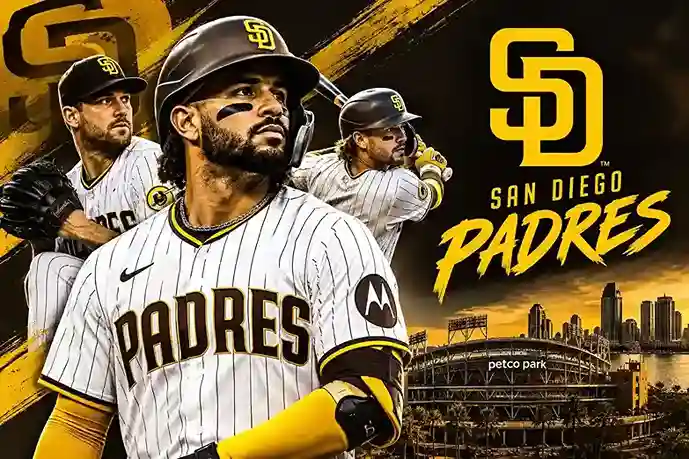
Few teams in baseball carry as much contrast as the San Diego Padres. This is a franchise that lost 110 games in its first big-league season, nearly moved to Washington, and has never lifted a World Series trophy. It is also the team that fills one of the best ballparks in the country night after night and keeps showing up in October.
The 2026 season has made that contrast sharper than ever. The Padres changed owners for a record price, handed the dugout to a first-time manager, climbed out of a mid-season slump, and then pushed the best team in baseball to the brink in the playoffs.
This guide pulls everything together: the latest news, the history that explains the fan culture, Petco Park, the players who built the legend, a head-to-head look at the Dodgers and Brewers, and what the next few years could look like.
San Diego Padres Latest Updates: What Has Happened in 2026
The Late-Season Surge and Another Playoff Berth
For most of the summer, this looked like a lost year. San Diego sat around .500 through July, and at one point trailed the Dodgers by roughly fifteen games in the National League West. A 50-53 record in late July gave little hint of what was coming.
Then the club flipped the switch. The San Diego Padres went on a run that CBS Sports described as 19 wins in 22 games, finished 91-71, and clinched a postseason spot on September 24 with a 4-2 win at Dodger Stadium. It was the third straight playoff trip, and Los Angeles, which finished about nine games ahead in the division, provided the backdrop for the celebration.
The Wild Card Series was a statement. The Padres swept the Chicago Cubs, winning 8-0 and then 4-1, and moved on to face Milwaukee.
The NLDS Against the Brewers
The Brewers won an MLB-best 103 games, and the first two games of the National League Division Series went their way, both by a single run. Milwaukee took Game 1 by a 3-2 score and Game 2 by 4-3, with Jackson Chourio delivering a two-out, two-run single off closer Mason Miller in the ninth inning.
Facing a sweep, the San Diego Padres answered at home on October 6. Jake Cronenworth’s go-ahead homer, Michael King’s two-inning relief appearance on one day of rest, and a game-ending double play started by Xander Bogaerts produced a 4-3 win. The series turned 2-1 in Milwaukee’s favor, and for the first time since 2021, a postseason series opened with three straight one-run games.
Game 4 was scheduled for Wednesday night, October 7, at Petco Park, with a deciding Game 5 in Milwaukee on Friday if needed. Check the live score for the final result, because this story is still moving.
Record $3.9 Billion Sale to José Feliciano and Kwanza Jones
The biggest off-field story is ownership. After the Seidler family began exploring a sale last November, a group led by private equity executive José E. Feliciano and his wife, Kwanza Jones, agreed to buy the team at a reported valuation of $3.9 billion. That figure shattered the old mark of roughly $2.4 billion set when Steve Cohen bought the Mets in 2020.
MLB owners approved the deal unanimously, and the new group holds a reported 40 percent stake while major minority investors stayed in place. For context, the previous ownership group paid $800 million for the club in 2012. The new owners have said publicly that they intend to build on the foundation the Seidlers laid.
A First-Time Manager in the Dugout
Mike Shildt retired after the 2025 season, citing the grind of the schedule. The front office stayed in-house and hired Craig Stammen, a former Padres reliever who had no managerial experience, on a three-year contract. He was picked over candidates that included Albert Pujols.
Stammen’s first season produced 91 wins and a division series appearance, which is a strong debut by any measure.
San Diego Padres History: From Expansion Punchline to October Regular
The Early Years: 1969 to the Kroc Rescue
The San Diego Padres entered the National League in 1969, after years as a popular Pacific Coast League club. The debut season was ugly, a 52-110 finish, and losing became the default for the next decade. Crowds thinned, finances wobbled, and by 1973 the club was close to relocating to Washington, D.C.
McDonald’s founder Ray Kroc bought the team in 1974 and kept it in town. His ownership brought stability and a larger-than-life personality, even if winning took longer to arrive.
The 1984 Pennant
Everything changed in 1984. The Padres beat the Chicago Cubs in the NLCS after dropping the first two games, rallying to win three straight at home. Steve Garvey’s walk-off homer in Game 4 became one of the most replayed moments in franchise history.
The World Series was less kind. Detroit beat San Diego four games to one, but the pennant proved that the city could host a serious contender.
1998: The Best Team in Franchise History
Fourteen years later, Bruce Bochy’s club won 98 games, the franchise record. Greg Vaughn hit 50 homers, Kevin Brown anchored the rotation, and the Padres beat Houston and Atlanta to reach the World Series again. The Yankees, one of the greatest teams ever assembled, swept them in four games.
Two trips to the Fall Classic, two defeats, and still no championship. That unfinished business shapes how fans talk about the San Diego Padres to this day.
Petco Park: The Home of the San Diego Padres
Why the Ballpark Works
Petco Park opened in 2004 on the edge of the Gaslamp Quarter and the East Village, and it remains a favorite among traveling fans. Skyline views, ocean breezes, and an open concourse design make it feel more like a neighborhood gathering spot than a concrete bowl.
The signature feature is the Western Metal Supply Co. building in left field. Rather than tear down the historic brick structure, the designers built it into the park. Today it holds suites, a team store, and a rooftop deck, and a ball that lands on its roof is remembered for years.
Game Day Atmosphere
Beyond the outfield wall, Gallagher Square gives families room to spread out on the grass, while the concourses offer craft beer, food from local vendors, and live music before first pitch. The Tony Gwynn statue on the grounds is a pilgrimage stop for fans who want a photo and a quiet moment.
The crowds have caught up with the setting. The San Diego Padres averaged 42,434 fans per home game in 2025, the second-highest figure in all of baseball, and the team has topped 3 million in attendance in each of the last three seasons. Playoff nights go even higher, with 47,773 packing the stands for Game 4 of the 2024 NLDS and 47,708 on hand for Game 3 this week.
San Diego Padres Roster: Legends and Current Stars
Tony Gwynn: The Greatest Padre
Nobody defines the franchise like Tony Gwynn. He spent all 20 of his seasons in San Diego, won eight National League batting titles, and finished with a .338 career average and more than 3,000 hits. Long before analytics departments existed, Gwynn was a pioneer of video analysis, dissecting both his own swing and the pitches of his opponents.
He entered the Baseball Hall of Fame in 2007. Even more telling, he turned down bigger paydays elsewhere to stay with the city that adopted him.
Trevor Hoffman and “Hells Bells”
When the opening chimes of AC/DC’s “Hells Bells” rang out, the game was effectively over. Trevor Hoffman saved 601 games in his career, most of them in a San Diego uniform, and he was the first pitcher to reach both 500 and 600 saves. His slow, disappearing changeup baffled hitters who knew exactly what was coming. The Hall of Fame inducted him in 2018.
The Current Core
The modern San Diego Padres lean on a mix of stars and homegrown talent. Fernando Tatis Jr. brings electricity, Manny Machado provides a veteran bat and glove at third base, and Xander Bogaerts remains a steady presence in the infield. Jake Cronenworth, Jackson Merrill, and young catcher Ethan Salas round out a group that has a blend of experience and upside.
On the mound, Michael King and Nick Pivetta, who returned from an elbow injury for the stretch run, lead the starters. Mason Miller handles the ninth inning, and his availability is one reason the bullpen matters so much in October. Miller was away on paternity leave for Game 3 of the NLDS, which put the pressure on King to cover the late innings.
San Diego Padres vs Dodgers: Head-to-Head Comparison
No opponent matters more to this fan base than Los Angeles. The two clubs share a division, a coastline, and, increasingly, October. Here is how they compare right now.
| Category | San Diego Padres | Los Angeles Dodgers |
| Home ballpark | Petco Park (opened 2004) | Dodger Stadium (opened 1962) |
| 2026 regular-season record | 91-71 | About 100-62 |
| 2026 NL West finish | 2nd, roughly 9 games back | 1st |
| World Series titles | 0 | 9 (through 2025) |
| World Series appearances | 2 (1984, 1998) | Many more, including recent titles |
| 2020 NLDS | Swept 3-0 | Won 3-0 |
| 2022 NLDS | Won 3-1 | Lost 3-1 |
| 2024 NLDS | Lost 3-2 | Won 3-2 |
| 2025 average home attendance | 42,434 (2nd in MLB) | Among the league leaders |
| Ownership | Feliciano and Jones group (2026) | Guggenheim Baseball Management |
What the Numbers Say
The Dodgers own the edge in titles, payroll muscle, and regular-season consistency. The San Diego Padres have shown they can beat LA in a short series, most memorably in 2022, when they toppled a 111-win Dodgers team in four games.
Postseason history between the two is a split: one sweep for each side and a five-game slugfest in 2024 that LA won. The rivalry is balanced enough in October to keep every regular-season series meaningful.
San Diego Padres vs Brewers: 2026 NLDS Head-to-Head
The Brewers entered as the better team on paper. How the two sides stack up this year:
| Category | San Diego Padres | Milwaukee Brewers |
| 2026 regular season | 91-71 | 103-59 (best in MLB) |
| Wild Card round | Swept Cubs 2-0 | Bye as a top seed |
| NLDS Game 1 | Lost 3-2 | Won 3-2 |
| NLDS Game 2 | Lost 4-3 | Won 4-3 |
| NLDS Game 3 | Won 4-3 | Lost 4-3 |
| Key arm | Michael King | Dustin May (Game 3 starter) |
| Form entering the series | Won 19 of 22 games | 12 straight postseason road losses |
| Manager | Craig Stammen (first season) | Veteran staff, 103-win club |
Milwaukee’s defense and bullpen kept games close, but their October road woes are a true plot point. If the series reaches Game 5, the Brewers get home-field advantage, though that streak of road playoff losses will not matter inside Milwaukee.
San Diego Padres Ownership: From Kroc to Feliciano
Ownership has shaped this team more than almost any other in baseball. Kroc saved the club in the 1970s. John Moores ran it through the 1990s and 2000s, including the Petco Park era, but payroll stayed modest. In 2012, a group led by the O’Malley family and Peter Seidler bought the team for $800 million.
Seidler became the primary owner in 2020 and pushed spending upward, helping drive attendance past 3 million and turning the Padres into a true big-market competitor. His death in November 2023 triggered a complicated family dispute over the trust that held his stake, which ended with the decision to sell.
Now the Feliciano and Jones group takes over with expectations as high as the price tag. Fans want to know whether the new owners will keep the aggressive approach to free agency, and whether the front office led by general manager A.J. Preller keeps its freedom to make bold trades.
San Diego Padres Franchise Milestones at a Glance
| Milestone | Detail |
| First MLB season | 1969 (52-110) |
| Best record in team history | 98-64 (1998) |
| Single-season home run record | 50, Greg Vaughn (1998) |
| Career batting average leader | .338, Tony Gwynn |
| Career saves | 601, Trevor Hoffman |
| World Series appearances | 1984 (lost to Detroit 4-1), 1998 (lost to New York 4-0) |
| Recent postseason streak | 2024, 2025 and 2026 |
| 2026 final regular-season record | 91-71 |
The pattern is clear. The San Diego Padres have had a handful of peaks, many valleys, and a recent run of consistency that is unfamiliar to long-time fans.
The Farm System and What Comes Next
Winning in October takes more than a star lineup, and the Padres know it. The organization has worked to blend big-name acquisitions with prospects who can supply cheaper production. Merrill’s emergence and Salas’s early opportunities show that the pipeline is still producing.
The harder part is balance. Big contracts, new ownership, and a competitive NL West mean the San Diego Padres cannot afford many missed bets. If the Feliciano group commits to both payroll and player development, the club has the ingredients to contend for years. If not, the margin for error is thin, because the Dodgers and Brewers are not slowing down.
Final Thoughts on the San Diego Padres
That is what makes this club easy to love. The ballpark is beautiful, the history is full of heartbreak and heroics, and the fans have not stopped believing during the 110-loss years or the near-misses since. Whether this October ends in Milwaukee or somewhere deeper in the bracket, the next chapter for the Padres is already being written, and a new ownership era makes it the most intriguing one in decades.
If you get the chance, go to Petco Park, arrive before sunset, and see why San Diego has become one of baseball’s best places to watch a game.