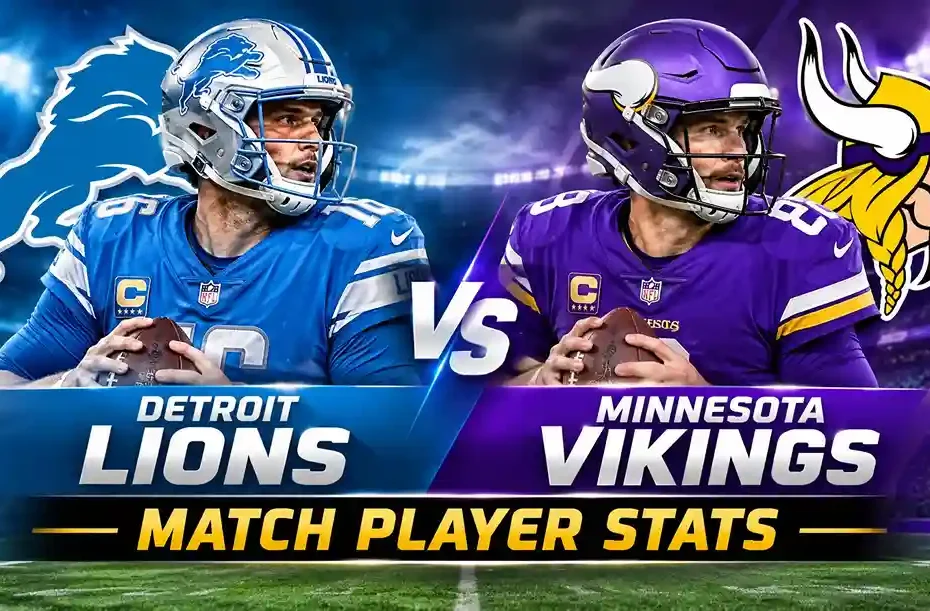
The scoreboard only tells part of any game. The deeper answers sit inside the Detroit Lions vs Minnesota Vikings match player stats: third-down efficiency, yards after contact, pressure rates and the small plays that quietly tilt a division battle.
This season those numbers matter more than usual. Minnesota arrives unbeaten at 6-0, while Detroit stands at 4-2 behind a quarterback who has not thrown a single interception. One side owns the league’s top defense by efficiency. The other owns one of the most productive offenses in the NFC.
This guide walks through every position group, shows which players are delivering, flags who is struggling, and closes with a full stat table plus a head-to-head comparison so you can see exactly where the advantage sits.
Latest Detroit Lions vs Minnesota Vikings Match Player Stats Updates
Plenty has changed since the last time these teams met, so start with the freshest developments before diving into individual performances.
- Standings: Minnesota is 6-0 and leads the NFC North. Detroit is 4-2 after beating the Saints, Jets, Cardinals and Packers, with losses to Buffalo and Carolina.
- New quarterback in Minnesota: Kyler Murray won the starting job over J.J. McCarthy during training camp on a one-year deal. Sam Darnold now plays in Seattle, so any older report listing him in this matchup is out of date.
- New play caller in Detroit: Drew Petzing took over the offense, and Jared Goff has adjusted smoothly.
- Latest form: Detroit edged Green Bay 20-17 right before this showdown. Goff threw for 303 yards and two touchdowns, and Amon-Ra St. Brown posted a season-high 153 receiving yards.
- Injury watch: St. Brown is working through an ankle issue and Jahmyr Gibbs has been managing a shoulder problem. Check the final injury designations before kickoff.
- Schedule: Week 8 kicks off Sunday at 1 p.m. ET on FOX from Ford Field. The rematch follows in Week 15 in Minneapolis on Sunday night.
- Last meeting: Minnesota won 23-10 on Christmas Day last season, which gives the Vikings a two-game winning streak in the series.
Why the Lions-Vikings Rivalry Keeps Producing Big Individual Numbers
Few divisional matchups feel as unpredictable as this one. Neither franchise plays timid football, and that aggressive mindset inflates individual stat lines in ways you rarely see elsewhere.
Detroit still runs the ball with conviction, hits play-action shots and goes for it on fourth down when Dan Campbell smells an opening. That approach feeds the backfield and the receiving corps at the same time.
Minnesota answers with a defense that currently ranks first in the league in EPA per play and smothers the pass. Kevin O’Connell’s offense leans on a veteran quarterback, a physical running back and one of the best receivers alive. When a high-powered offense collides with a top-ranked defense, the result is a chess match where every snap shows up in the box score.
Familiarity adds another layer. Goff has now faced Brian Flores’s defense six times, and both staffs know each other’s tendencies by heart. Coaches target specific weaknesses, which produces outlier performances in both directions.
Detroit Lions vs Minnesota Vikings Match Player Stats: Quarterback Showdown
No position shapes this rivalry more than quarterback. The 2026 numbers show two very different seasons.
Jared Goff and Detroit’s Efficient Attack
Goff has been nearly flawless. He has completed 150 of 223 passes (67.3 percent) for 1,788 yards, 14 touchdowns and zero interceptions, averaging a healthy 8.0 yards per attempt. His touchdown rate ranks among the top five in the league, and his fantasy output sits second among quarterbacks.
Minnesota has historically made life hard on him, though. Over the two meetings last season, the Vikings sacked Goff five times in each game and pressured him on roughly 41 and 43 percent of his dropbacks. Flores also adjusted between games, raising his blitz rate from about 33 percent in the first meeting to nearly 59 percent in the rematch. In the most recent clash, Goff completed 18 of 29 passes for 197 yards with one touchdown and two interceptions while the Lions gave the ball away five times.
His best path forward runs through play-action. Minnesota has surrendered 8.5 yards per attempt on those throws, which ranks 26th in the league. If Detroit’s offensive line holds up, Goff can attack that weakness.
Kyler Murray Steering Minnesota’s Offense
Murray has not been as sharp as many expected. He has completed 83 of 125 passes (66.4 percent) for 812 yards, three touchdowns and two interceptions, averaging roughly 162 passing yards per game. Minnesota’s passing attack still searches for rhythm, and Murray has absorbed 12 sacks in five appearances.
His legs add a dimension that Detroit’s defense must respect. He has picked up 132 rushing yards on 25 carries, and those scrambles often convert third downs that look dead on paper. Backup Carson Wentz stepped in for two games and completed 23 of 39 passes for 276 yards and three touchdowns, so the offense has produced when protection holds.
Pressure remains the central question. When Detroit’s front collapses the pocket, Murray must either escape or throw into tight windows. Sacks and turnovers in this matchup will likely reveal who wins the quarterback battle.
Running Back Battle: Who Controls the Ground Game?
The team that controls the clock usually controls this rivalry, and each side features a back who can swing the game with one cutback lane.
Jahmyr Gibbs and the Explosive Play Factor
Gibbs is the engine of Detroit’s offense. He has handled 166 touches, including 134 carries and 32 receptions, and produced 620 rushing yards at 4.6 yards per carry along with 270 receiving yards and nine total touchdowns. That pace works out to roughly 103 rushing yards per game, putting him on track to challenge his career-high of 1,412 yards from 2024. The Lions also locked him in with a three-year, $67.5 million extension.
Defenses cannot key on him because he threatens as both runner and receiver. Linebackers hesitate for half a second trying to diagnose the play, and Gibbs punishes that delay.
Minnesota presents a fascinating test. The Vikings allow only 4.2 yards per carry, yet they rank just ninth in EPA per rush, which makes them more vulnerable on the ground than through the air. Gibbs may find his best opportunities there.
Aaron Jones and Minnesota’s Power Approach
Aaron Jones leads the Vikings with 105 carries for 436 yards and two touchdowns, averaging 4.2 yards per carry. He attacks the line of scrimmage with a lower center of gravity and gives Minnesota a dependable option on short-yardage downs.
Jordan Mason returned from injury recently and added 15 carries for 59 yards and a touchdown in his first game back, so the workload may shift slightly. A healthier backfield gives O’Connell more freedom to keep Jones fresh for the fourth quarter.
Because Murray has taken so many sacks, Jones’s reliability on third down and in protection matters as much as his yardage total.
Wide Receiver and Tight End Production Breakdown
Both rosters feature elite route runners, and their matchups generate the explosive plays that dominate post-game highlights.
Amon-Ra St. Brown’s Route-Running Mastery
St. Brown leads Detroit with 46 catches for 525 yards and five touchdowns. His quick release against press coverage creates instant separation, and he finds soft spots in zone defenses with remarkable consistency. He keeps the chains moving, which is why defensive coordinators dread him on third down.
His season-high 153 yards against Green Bay shows how quickly he can take over. The ankle issue deserves attention, but Campbell has said he should be good to play.
Detroit also enjoys more balance than in past years. Jameson Williams has caught 13 passes for 240 yards and four touchdowns over his last three games, and tight end Sam LaPorta is back in the mix after missing time last year. That depth prevents Minnesota from rolling coverage toward one player.
Justin Jefferson’s Big-Play Threat
Justin Jefferson remains the most dangerous receiver on the field, even though his numbers look modest. He has 23 catches for 302 yards and three touchdowns, a total held back by Minnesota’s inconsistent passing game rather than any decline in his own play. Jordan Addison adds 13 receptions for 183 yards and a score.
Jefferson wins contested catches and punishes safeties who creep forward. A single deep connection can rewrite a game, and Detroit’s secondary must stay disciplined at the top of every route. If Murray finds a rhythm with him early, the Vikings’ passing stats could jump sharply.
Defensive Standouts: Sacks, Interceptions, and Tackles
Defense wins division titles, and the individual defensive numbers reveal who shows up when pressure peaks.
Aidan Hutchinson’s Pass Rush in the Lions vs Vikings Player Stats
Aidan Hutchinson opened the season with 3.5 sacks through his first five games, following a career-best 14.5 sacks and second-team All-Pro recognition last year. He generated 100 total pressures in that campaign, and his combination of speed and power continues to trouble offensive tackles.
Minnesota’s line must answer him every snap. Because Murray has already been sacked 12 times in five appearances, Hutchinson’s matchup could define the afternoon. He also sets a firm edge against the run, forcing backs to cut inside toward Detroit’s interior defenders. That discipline rarely makes a highlight reel, but it shows up in rushing yards allowed.
Linebacker Jack Campbell anchors the middle with 54 tackles, tied for the team lead with Minnesota’s Blake Cashman.
Minnesota’s Defensive Numbers That Stand Out
The Vikings own the top-ranked defense by EPA per play. They allow the fourth-fewest passing yards per game, have given up just six passing touchdowns and have surrendered only one pass longer than 40 yards.
Dallas Turner leads the pass rush with six sacks, followed by DJ Wonnum with five. Pro Football Focus grades the unit as the league’s 12th-best rushing group, which suggests more room to grow. In the secondary, cornerback Byron Murphy Jr. has three interceptions, and the group limits yards after the catch, which neutralizes short completions to St. Brown and Gibbs.
Complete Detroit Lions vs Minnesota Vikings Match Player Stats Table
The table below captures the key 2026 season numbers entering Week 8, giving you a clear picture of how each standout stacks up.
| Player | Team | Position | 2026 Production | TDs | Key Stat |
|---|---|---|---|---|---|
| Jared Goff | DET | QB | 1,788 pass yds | 14 | 67.3% comp, 0 INT |
| Kyler Murray | MIN | QB | 812 pass yds | 3 | 66.4% comp, 12 sacks taken |
| Jahmyr Gibbs | DET | RB | 620 rush / 270 rec yds | 9 | 4.6 YPC |
| Aaron Jones | MIN | RB | 436 rush yds | 2 | 4.2 YPC |
| Amon-Ra St. Brown | DET | WR | 525 rec yds | 5 | 46 catches |
| Justin Jefferson | MIN | WR | 302 rec yds | 3 | 23 catches |
| Aidan Hutchinson | DET | EDGE | 3.5 sacks (first 5 games) | — | 100 pressures in 2025 |
| Dallas Turner | MIN | LB | 6 sacks | — | Team sack leader |
| Byron Murphy Jr. | MIN | CB | 3 interceptions | — | Team interception leader |
Reading the table side by side, Detroit holds a clear advantage in quarterback efficiency and offensive volume, while Minnesota counters with defensive playmaking and a lethal downfield weapon. The margins stay thin enough that one turnover could flip the entire matchup.
Head-to-Head Comparison: Lions vs Vikings Player by Player
Putting both rosters on the same scale makes the contrast easier to see. Here is how each category compares.
| Category | Detroit Lions | Minnesota Vikings | Edge |
|---|---|---|---|
| Record | 4-2 | 6-0 | Vikings |
| Starting QB passing yards | Goff: 1,788 | Murray: 812 | Lions |
| QB touchdown-to-interception | 14 TD, 0 INT | 3 TD, 2 INT | Lions |
| Lead running back yards | Gibbs: 620 | Jones: 436 | Lions |
| Lead receiver yards | St. Brown: 525 | Jefferson: 302 | Lions |
| Top pass rusher | Hutchinson: 3.5 sacks (5 games) | Turner: 6 sacks | Vikings |
| Leading tackler | Campbell: 54 | Cashman: 54 | Even |
| Defensive efficiency | Allowing big plays | No. 1 in EPA per play | Vikings |
| All-time series | 45 wins | 82 wins (2 ties) | Vikings |
The pattern is clear. Detroit wins nearly every offensive column, while Minnesota controls the defensive side and the history. The matchup that decides the game is simple: Detroit’s top-tier offense against Minnesota’s top-tier defense.
Special Teams and Hidden Stats That Swing Games
Special teams rarely earn headlines, yet they influence field position in nearly every Lions-Vikings game.
Minnesota’s return game has been a quiet weapon. Myles Price has averaged 30.7 yards on 18 kickoff returns with a long of 68, and he has posted 250 punt return yards on 13 attempts, including an 86-yard touchdown. A short field for Murray and Jones can erase the advantage Detroit’s defense hopes to build.
Detroit relies on kicker Jake Bates, who went 2-for-2 on field goals in the three-point win over Green Bay. Considering that the Lions have already won games by one point, three points and seven points this season, kicking accuracy has real weight. Long field goals in the fourth quarter could easily settle this contest.
Head-to-Head Historical Player Stats Trends
Zooming out reveals a series that has leaned heavily toward Minnesota. Across 129 meetings, the Vikings lead 82-45-2. Detroit’s longest winning streak is five games, which it reached between 2022 and 2024, while Minnesota once won 13 in a row. The Vikings swept the Lions last season and have won two straight.
Goff’s history against Flores explains much of that recent trend. In six meetings, Goff produced two top-tier fantasy weeks and three finishes ranked 22nd or lower among quarterbacks. Pressure, sacks and turnovers separated the good days from the bad ones.
Two patterns repeat across this rivalry. First, protecting the football decides close games, and Goff’s zero-interception start gives Detroit a rare edge there. Second, the team that wins the pass-rush battle usually dictates the quarterback matchup, whether that means Hutchinson against Minnesota’s tackles or Turner and Wonnum against Detroit’s line.
Final Whistle: What These Numbers Mean Going Forward
The Detroit Lions vs Minnesota Vikings match player stats paint a picture of two contenders with opposite strengths. Detroit brings an efficient, high-volume offense led by Goff, Gibbs and St. Brown. Minnesota counters with a suffocating defense, a dangerous downfield threat in Jefferson and an unbeaten record that proves it knows how to finish.
If you want to predict the outcome, look past the highlight reels. Watch the pressure rate on both quarterbacks, the yards after contact from each running back and the turnover margin. Those quieter numbers usually separate winners from losers in the NFC North.
Bookmark this page and return after the next meeting. The stats will shift, new heroes will emerge, and this rivalry will keep delivering performances that deserve more attention than a standard box score can give.