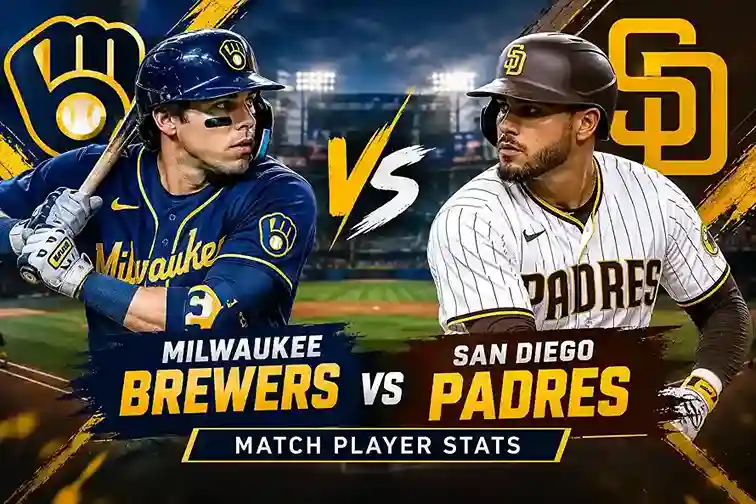
The Milwaukee Brewers vs San Diego Padres match player stats have never mattered more than they do right now. The two clubs with the best records in baseball since the All-Star break are meeting in the 2026 National League Division Series, and the first two games were decided by a single run each.
This guide was updated on October 7, 2026. It covers the latest NLDS results, the individual player numbers behind them, the full pitching picture and the key matchups to watch as the series moves through Petco Park. If you want to understand why this series is so tight, start with the players.
Milwaukee Brewers vs San Diego Padres Match Player Stats: Latest NLDS Update
Milwaukee entered the postseason as the National League’s No. 1 seed after a 103-59 regular season. San Diego went 91-71, then swept the Chicago Cubs in the Wild Card Series. Since the All-Star break, the Brewers went 44-22 and the Padres 43-23, which is why many analysts called this the “real World Series” matchup.
The Padres did win the 2026 regular-season series 4-2, including a three-game sweep at Petco Park in August. In May, the Brewers won two of three games at home. Those split results explain why oddsmakers opened Milwaukee as modest favorites rather than heavy ones.
Game 1: Brewers 3, Padres 2
Game 1 at American Family Field on October 3 was a lesson in how individual player performances swing a series. San Diego jumped ahead 2-0 in the second inning on a Luis Campusano single and a Jake Cronenworth fielder’s choice.
Jackson Chourio answered in the third with a two-run homer that traveled 420 feet and tied the game. William Contreras then broke the tie in the seventh with a 406-foot home run off Adrian Morejon. Contreras had gone just 1-for-20 against San Diego during the regular season before that swing.
The ninth inning added drama. Ty France hit a towering fly ball that struck a railing on the roof before Chourio caught it for an out. The call was upheld despite the Padres’ challenge. San Diego also loaded the bases in the seventh and put two runners on in the eighth without scoring, and DL Hall earned the win in relief.
Jacob Misiorowski struck out six in his Game 1 start. The Padres fouled off 30 of his 88 pitches, which shortened his outing and forced Milwaukee to lean on its bullpen.
Game 2: Brewers 4, Padres 3
Game 2 on October 4 delivered one of the biggest comebacks in Brewers postseason history. San Diego led 3-2 entering the bottom of the ninth with closer Mason Miller on the mound.
With two outs and the bases loaded, Chourio lined a two-run single to win it. Miller threw a season-high 40 pitches, topped 100 mph with 18 of them and reached 103.5 mph on the pitch Chourio fouled off. At 22 years and 207 days old, Chourio became the second-youngest player to record a postseason walk-off hit.
The numbers behind the Padres’ frustration are stark. San Diego went 3-for-18 with runners in scoring position across the first two games and left 20 runners on base. Milwaukee, meanwhile, hit just .190 as a team through two games and still won both.
Game 3 and What Comes Next
Game 3 was scheduled for Tuesday, October 6, at Petco Park, with the Brewers one win from a sweep. At the time of this update, the final result of Game 3 was not yet confirmed in the sources used, so check the latest box score before you cite the series score.
The schedule from here is simple. If San Diego won Game 3, Game 4 is Wednesday night, October 7, at Petco Park. A deciding Game 5, if needed, returns to American Family Field on Friday, October 9.
Team Stats: Brewers vs Padres Season Comparison
Before diving into individual players, the team-level numbers frame the series. These are the 2026 regular-season figures listed for both clubs entering the NLDS.
| Category | Milwaukee Brewers | San Diego Padres |
| Record | 103-59 | 91-71 |
| Batting Average | .258 | .244 |
| On-Base Percentage | .341 | .319 |
| Slugging Percentage | .403 | .398 |
| Home Runs | 154 | 183 |
| Runs Scored | 832 | 722 |
| Team ERA | 3.51 | 3.99 |
| WHIP | 1.18 | 1.29 |
| Opponent Batting Average | .221 | .242 |
The pattern is clear. San Diego hits more home runs, while Milwaukee gets on base more, scores more runs and prevents more of them. The Brewers led the majors in batting average, ranked second in walks and finished first in OPS with runners in scoring position. Both teams run, too: Milwaukee stole 162 bases and San Diego stole 164.
The Milwaukee Brewers vs. San Diego Padres player stats tale revolves around this contrast. One side wins through contact and pressure. The other wins through power and elite late-inning arms.
Brewers Player Stats That Decide the Matchup
Milwaukee’s depth is its biggest weapon. The lineup has no soft spots, and the pitching staff is anchored by one of the most dominant seasons in recent memory.
Jackson Chourio: The Series MVP So Far
Chourio finished the regular season at .291/.351/.487 with 25 home runs and 23 stolen bases. He became the first player in MLB history with three 20-homer, 20-steal seasons before turning 23.
His September was even better: .337/.389/.531 with five home runs, 18 RBI and nine steals. Over the final two months, he slugged .767 against fastballs, a number that matters against a Padres staff built on velocity.
In October, Chourio has been even more dangerous. He owns a .327 average with a franchise-record five postseason home runs and 15 RBI in 14 career playoff games. He also went into Game 3 without a strikeout in eight NLDS at-bats against San Diego.
Jacob Misiorowski: The Ace Padres Hitters Cannot Time
Misiorowski led the league with a 1.80 ERA and 252 strikeouts, finishing 16-5 with a 2.17 FIP. He was the NL Cy Young frontrunner heading into the postseason, and the Brewers had won nine straight of his starts at one point late in the year, allowing just 2.2 runs per game in that stretch.
His Game 1 outing showed the one adjustment San Diego found: patience. Fouling off pitches drove his count up and ended his night earlier than normal. If a Game 5 happens, that approach will be tested again.
William Contreras and the Middle of the Order
Contreras is the type of hitter who changes a series with one swing. His Game 1 home run was his first real damage against the Padres this year after a 1-for-20 regular-season stretch. He anchors a lineup that also includes Jake Bauers, Christian Yelich, Garrett Mitchell and Sal Frelick.
Yelich remains a useful veteran bat. He is 7-for-18 with two home runs in his career against Nick Pivetta, which makes him one of the key individual matchups in Game 3 and any later start by Pivetta.
Brice Turang and the Table Setters
Turang has become the engine of Milwaukee’s offense after back-to-back elite seasons at second base. He was still searching for his first hit in the series entering Game 3, which is a pattern worth watching. When Turang gets on base ahead of Chourio, Milwaukee’s lineup becomes far more dangerous.
San Diego Padres Player Stats That Turn Heads
San Diego’s formula is stars on both sides of the ball, and the regular-season numbers show a team that found its power late.
Fernando Tatis Jr.: From Slump to Superstar
Tatis hit zero home runs in the first two months of 2026. From May 30 on, he hit 25, and he posted a 1.012 OPS over the final 30 days. He also stole 38 bases and remains a two-time Gold Glove and two-time Platinum Glove winner in right field.
His wRC+ of 172 after the All-Star break ranked among the best in baseball. Against the Brewers, Tatis scored in Game 2 and has been a constant threat on the bases.
Manny Machado: Power and Defense at Third Base
Machado did not have the season he wanted at the plate, but he still hit 30 home runs and led all third basemen with a +8 fielding run value. In the postseason he has a home run and two RBI, and he has been working tough at-bats throughout October.
His career numbers against Dustin May are worth noting. Machado is 10-for-40 with two home runs against May overall, but only 1-for-9 against him this season. That is a fascinating Game 3 subplot.
Jackson Merrill and Ty France: The Support Bats
Merrill hit 26 home runs and delivered the tying sacrifice fly in a late-season win over Milwaukee. France added 21 homers and began the postseason with seven hits in his first 15 at-bats. He was also inches from a go-ahead homer in Game 1, when the roof caught his drive, and that one play could have changed the entire series.
Behind them, Xander Bogaerts, Gavin Sheets and Dustin Harris have all contributed in October. The Padres hit 183 home runs as a team, so no Brewers pitcher can relax against any spot in the order.
Michael King and Nick Pivetta: The Starters
Michael King has 14 strikeouts this postseason and gives the Padres their most reliable front-line arm. Pivetta is the larger storyline: after missing nearly five months with a right elbow flexor injury, he returned in September and posted a 1.64 ERA across his starts since reinstatement. His season line is 3-2 with a 2.86 ERA, and he generated a 35.5% chase rate with hitters making contact on just 59.2% of swings outside the zone.
Mason Miller: Elite Closer, Rare Stumble
Miller struck out 129 batters in 70 innings, a 16.6 strikeouts-per-nine rate that ranks fourth-highest ever among pitchers with at least 50 innings. Game 2 was a rare crack, but his raw numbers remain among the best in baseball. Padres manager Craig Stammen has to decide how aggressively to use him, especially in games that require six-out saves.
Pitching and Bullpen: Where the Series Will Be Won
Pitching has dictated almost every inning so far. Milwaukee posted the lower team ERA (3.51 versus 3.99) and WHIP (1.18 versus 1.29), and its opponents hit just .221 against it.
The Padres counter with a better closer. Miller, supported by Morejon and Yuki Matsui, gives San Diego the most dominant back end in the series. Milwaukee answers with depth: DL Hall, Abner Uribe and Trevor Megill, who picked up the Game 2 win, have all been trusted in high-leverage innings.
Milwaukee also won 42 games in come-from-behind fashion during the regular season, tied for fifth most in MLB. That experience showed in both NLDS wins.
Game 3 Pitching Duel: Dustin May vs Nick Pivetta
The most revealing Milwaukee Brewers vs San Diego Padres match player stats for Game 3 come from the starting pitchers.
Dustin May
May finished 7-9 with a 4.70 ERA as a Trade Deadline pickup. He allowed just three earned runs over his first 13 innings with Milwaukee before going 1-2 with a 7.61 ERA over his final eight outings. Even so, manager Pat Murphy stuck with him because of his numbers against San Diego: a 1.23 ERA with 22 strikeouts in 22 innings across three starts this season, and a 3.14 ERA in 16 career games against the Padres.
Nick Pivetta
Pivetta is dealing with a sellout crowd and an elimination game at Petco Park, where the Padres went 53-30 this year. His career numbers against Milwaukee are rough, including a reported 8.76 ERA, but most of that damage came years ago. The Brewers also had little recent history against him.
Teams down 0-2 in a best-of-five series have come back to win only 10 times in 93 tries. San Diego needs its home-field edge, its starter and its bats to show up at once.
Key Player Matchups to Watch in the Rest of the Series
Here are the individual battles most likely to decide the NLDS:
- Chourio vs Padres bullpen: Chourio has delivered in the biggest moments, and he hit .333 against left-handers during the regular season compared with .274 against right-handers.
- Tatis vs Brewers outfield defense: Tatis’ speed turns singles into doubles, and Milwaukee’s outfield must stay disciplined.
- Machado vs Dustin May: A small sample this season, a big career history.
- Yelich vs Pivetta: Seven hits in 18 at-bats, including two homers, is a meaningful edge.
- Padres with runners in scoring position: A 3-for-18 start cannot last if the bats are as good as the season numbers suggest.
- Brewers baserunning: Milwaukee had seven players with at least 10 steals, and Padres catchers will face constant pressure.
Final Verdict: What the Stats Say About Brewers vs Padres
The Milwaukee Brewers vs San Diego Padres match player stats point to a series that is much closer than the standings suggest. Milwaukee has the better team ERA, the better on-base numbers, a historic young star in Chourio and a Cy Young-caliber ace in Misiorowski. San Diego has more power, a better closer, the best home record of the two and a lineup that can erupt in any inning.
The late surge, the clutch single, and the discipline at the plate are just a few examples of how the Brewers have won. The Padres have lost because they have not cashed in their chances, with 20 stranded runners in two games.
If the Padres stay alive, expect the series to turn on whether their stars finally hit with runners on base. If Milwaukee finishes the job, it will be because the Brewers once again turned a close game into a statistical edge when it counted most.
Bookmark this page and check back after each game. We update the player numbers as the series develops.