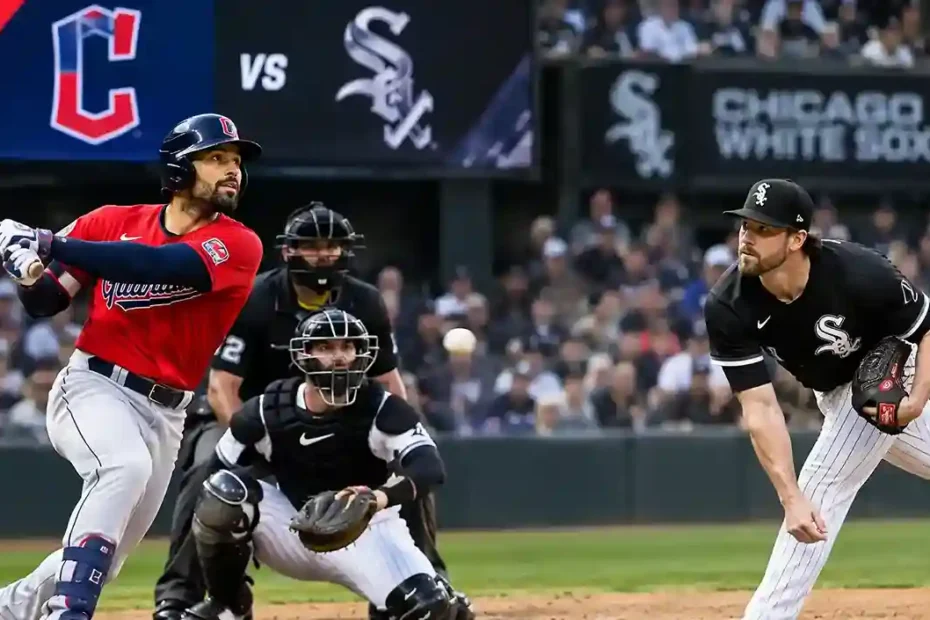
The AL Central rivals have never met in October before. That changes today. The Guardians host the White Sox in Game 1 of the American League Division Series, and every number from their 13 regular-season meetings suddenly matters.
If you want the most current Cleveland Guardians vs White Sox match player stats, this guide pulls together the 2026 season series, the hitters and pitchers who will swing the series, and the team-level numbers that explain why this matchup is closer than the standings suggest.
Latest Update: Guardians and White Sox Meet in the 2026 ALDS
Cleveland finished 85-77 and took the AL Central, earning a first-round bye. Chicago finished 84-78, one game back, and then swept the Houston Astros in the Wild Card Series for its first postseason series win in 21 years. The two clubs are separated by a single game in the final standings, which tells you how even this division race was.
The best-of-five series runs on TBS, truTV and HBO Max. Here is the schedule:
- Game 1: Saturday, October 3, 1:00 p.m. ET at Progressive Field
- Game 2: Monday, October 5, 5:00 p.m. ET
- Game 3: Wednesday, October 7, 4:00 p.m. ET
- Game 4 (if needed): Thursday, October 8, 5:00 p.m. ET
- Game 5 (if needed): Saturday, October 10, 5:00 p.m. ET
The first two games feature a contrast in philosophy. Cleveland starts rookie left-hander Parker Messick, with Gavin Williams following in Game 2. Chicago plans to open Game 1 with rookie reliever Hagen Smith and lean on a bullpen game, a plan that fits the Guardians’ left-handed core of Steven Kwan and Chase DeLauter.
The season series favored Chicago 7-6 this year. That is a sharp reversal from 2025, when Cleveland won 11 of 13. Stats from last season carry far less weight than you might expect, because both rosters changed significantly.
2026 Season Series: How the Games Played Out
The head-to-head results show a rivalry decided by late innings and one big swing. These games give the clearest picture of how Cleveland Guardians vs White Sox match player stats translated into results this year.
| Date | Result | Player Highlight |
|---|---|---|
| June 22 | White Sox 6, Guardians 5 | Sam Antonacci’s walk-off two-run single in the ninth, after Cleveland had scored twice in the top half to take the lead |
| August 8 | White Sox 6, Guardians 3 | Munetaka Murakami homered; Tristan Peters and Chase Meidroth each drove in two runs in a five-run sixth |
| August 9 | White Sox 5, Guardians 3 | Colson Montgomery’s 26th homer, a three-run shot, capped a four-run third inning |
| September 14 | White Sox 7, Guardians 3 | Chicago opened the final series with a comfortable win |
| September 15 | Guardians 7, White Sox 6 | Cleveland answered in a one-run game |
| September 16 | Guardians 6, White Sox 3 | Petey Halpin’s three-run homer and eight strikeouts from Messick moved Cleveland into first place |
Two patterns stand out. First, Chicago’s wins came from power at the plate and rallies built around one big inning. Second, Cleveland’s best result came when Messick controlled the game, which is exactly the formula the Guardians need in October.
Note that the June 22 meeting is less predictive than the others. Ramírez, DeLauter and Angel Martínez were all on the injured list at that point, so the lineup Cleveland brings to the ALDS looks different from the one Chicago faced early in the summer.
Team Stats Comparison: Offense vs Pitching
Team numbers frame the individual matchups. Chicago has the better offense, and Cleveland has the better pitching staff.
| Category | Cleveland Guardians | Chicago White Sox |
|---|---|---|
| Batting average | .239 | .236 |
| On-base percentage | .316 | .320 |
| Slugging percentage | .380 | .406 |
| Home runs | 162 | 211 |
| Runs scored | 678 | 776 |
| Team ERA | 3.77 | 4.12 |
| Team WHIP | 1.26 | 1.31 |
| Team FIP | 3.82 | 4.25 |
| Strikeouts per 9 innings | 9.6 | 8.4 |
The gap in power is large. Chicago finished fifth in the majors in home runs, while Cleveland ranked 27th in both home runs and slugging. The Guardians also sat 24th in runs scored. After the August 3 trade deadline, however, Cleveland ranked eighth in runs and tied Chicago for eighth in OPS, thanks to deadline additions Nathaniel Lowe and Jo Adell. So the full-season gap overstates how far apart the lineups are today.
On the other side, Cleveland’s pitchers posted a lower ERA, a lower FIP and a higher strikeout rate. One caution for the numbers-minded: Chicago’s run differential produced an 87-75 Pythagorean record, compared with 82-80 for Cleveland. The White Sox may have been a slightly better team than their record, which is a reminder not to dismiss them as underdogs.
Guardians Hitters: Player Stats That Matter in This Series
José Ramírez: The Biggest Variable
Although Ramírez is still the team’s face, this season was unlike any other. He underwent surgery for a fractured left hamate bone in June. Before the injury he posted a 111 wRC+, which is above average, and his expected stats were even better. After returning, that figure fell to 66, and he managed a .598 OPS with two home runs after the All-Star break.
For the Guardians, the question is simple: does the hamate recovery finally clear up in October? Ramírez is a seven-time All-Star, and a healthy version changes how Chicago has to pitch the entire lineup. If his bat returns to form, the Guardians’ lineup looks far more dangerous than the regular-season rankings suggest.
Chase DeLauter and Steven Kwan: The Left-Handed Core
DeLauter was Cleveland’s most productive regular hitter by OPS, and he gives the lineup a power threat it lacked early in the year. Kwan continued to get on base at a high rate, and his contact-first approach remains the engine of the offense.
Both bat left-handed, which is exactly why Chicago is willing to open with Hagen Smith. Expect the White Sox to try to neutralize them early with lefty arms and a fast hook.
Deadline Additions and Role Players
Lowe and Adell lengthened the lineup after August 3, and second baseman Travis Bazzana provided a late-season jolt. Angel Martínez also had a breakthrough year. Combined, these bats give Ramírez more support than he had in some earlier Cleveland postseason runs.
White Sox Hitters: Player Stats That Matter in This Series
Munetaka Murakami: Power With Strikeouts
Murakami’s first MLB season delivered what the scouting reports promised. He hit 35 home runs with a .347 on-base percentage and a .478 slugging percentage over 127 games, but also struck out 196 times in 454 at-bats and hit .207.
His numbers against Cleveland tell a similar story. In six games he went 3-for-19 with two home runs, five walks and 12 strikeouts. That is classic Murakami: very few balls in play, but a lot of damage when he connects. He missed a lot of time due to injuries as well. He produced a 158 wRC+ before it and 107 afterward, so Chicago needs the early-season version to return.
Colson Montgomery and Miguel Vargas
Murakami, Montgomery and Vargas each finished with more than 30 home runs, giving Chicago three players who can change a game with one swing. Montgomery’s homer on August 9 against Cleveland is a good example. Vargas, meanwhile, comes into the series on a hot streak, which matters more than a season-long average in a short series.
Chase Meidroth and Sam Antonacci
Meidroth, acquired in the Garrett Crochet trade with Boston, finished fourth in fWAR among all MLB second basemen and drove in two runs in Chicago’s August 8 win. Antonacci delivered the walk-off on June 22. Together they give the White Sox something Cleveland has lacked in stretches: an above-average bat at the bottom half of the order.
Pitching Duel: Messick, Williams and the White Sox Bullpen
The pitching matchup is where the Guardians have their clearest advantage, so these are the most important Cleveland Guardians vs White Sox match player stats in the series.
| Pitcher | Team | Key 2026 Numbers |
|---|---|---|
| Parker Messick | Cleveland | 12-9, 2.56 ERA, 193 K, 49 BB in 186⅓ IP over 32 starts |
| Gavin Williams | Cleveland | AL-leading 248 K in 184⅓ IP |
| Hagen Smith | Chicago | 3-3, 1.29 ERA, 41 K in 28 IP over 18 appearances |
| Sean Burke | Chicago | 3.34 ERA, 3.62 FIP, 185 K in 172⅓ IP |
Parker Messick: A Rookie Ace Against His Rival
Messick has come a long way in a year. He was not on the Guardians’ 2025 wild-card roster, yet he now owns the seventh-best ERA in the majors and enters the Cy Young and Rookie of the Year conversations. He will be the first rookie to start a postseason game for Cleveland since 2016.
Against Chicago he has been especially strong, going 2-1 with a 2.81 ERA in five starts this season. He also struck out eight in the September 16 win that put Cleveland in first place. Chicago will need to get to him early, as it did against Astros ace Hunter Brown in the Wild Card Series.
Gavin Williams: The Strikeout Leader
Williams led the American League with 248 strikeouts and took a major step up this season. Manager Stephen Vogt chose him for Game 2 after extra rest, and noted that Messick and Williams have been the team’s two best pitchers. With power-heavy Chicago striking out so often, his swing-and-miss profile fits the matchup.
Chicago’s Bullpen Plan
The White Sox will not match Cleveland’s rotation arm for arm. Instead they plan to mix and match, using Hagen Smith, Davis Martin and a deep relief group. Smith has been excellent in short bursts and threw three scoreless innings in the Wild Card opener against Houston. The risk is workload: a bullpen game in a five-game series can strain the staff by Game 4.
Player Stats Breakdown: Where Each Team Holds the Edge
Putting the Guardians vs White Sox player stats side by side, the advantages are clear:
- Starting pitching: Cleveland. Messick and Williams are the two best starters in the series by a wide margin.
- Power hitting: Chicago. Three 30-homer bats against a Guardians lineup that ranked near the bottom in home runs.
- Strikeout risk: Chicago carries more of it. Murakami and Colson Montgomery strike out a lot, and Cleveland’s staff posted a 9.6 K/9.
- Star power: Cleveland, with a caveat. Ramírez is the best player on either roster, but only if he is healthy.
- Depth: Slight edge to Chicago. Meidroth, Antonacci and Peters give the lineup extra length.
- Late innings: Cleveland, slightly. The Guardians have a strong back end of the bullpen, while Chicago leans on matchup-driven usage.
What to Watch Over the Next Five Games
Three questions will decide the series. First, can Chicago score early against Messick before Cleveland’s bullpen takes over? Second, will Ramírez look like the player who produced a 111 wRC+ before surgery, or the one who posted a 66 afterward? Third, can Murakami and Montgomery put the ball in play often enough to punish Cleveland’s pitchers?
Remember that sample sizes in a best-of-five series are tiny. A single hanging slider or a lucky bounce can outweigh a full season of data. That is why the best way to use Cleveland Guardians vs White Sox match player stats is as a guide to likely outcomes, not a guarantee. Check live box scores on MLB.com, ESPN or Baseball Reference after each game to track how these numbers evolve.
Final Thoughts on Cleveland Guardians vs White Sox Match Player Stats
The numbers paint a clear but narrow picture. Cleveland has the stronger pitching, a rookie ace and the home-field advantage, while Chicago owns more power, more depth and a 7-6 edge in the season series. This is a genuine toss-up that could turn on one big swing or one rookie’s October nerves.
Bookmark this page and return after each game. We will keep refreshing the Cleveland Guardians vs White Sox match player stats as the ALDS unfolds, so you always have the latest numbers in one place.