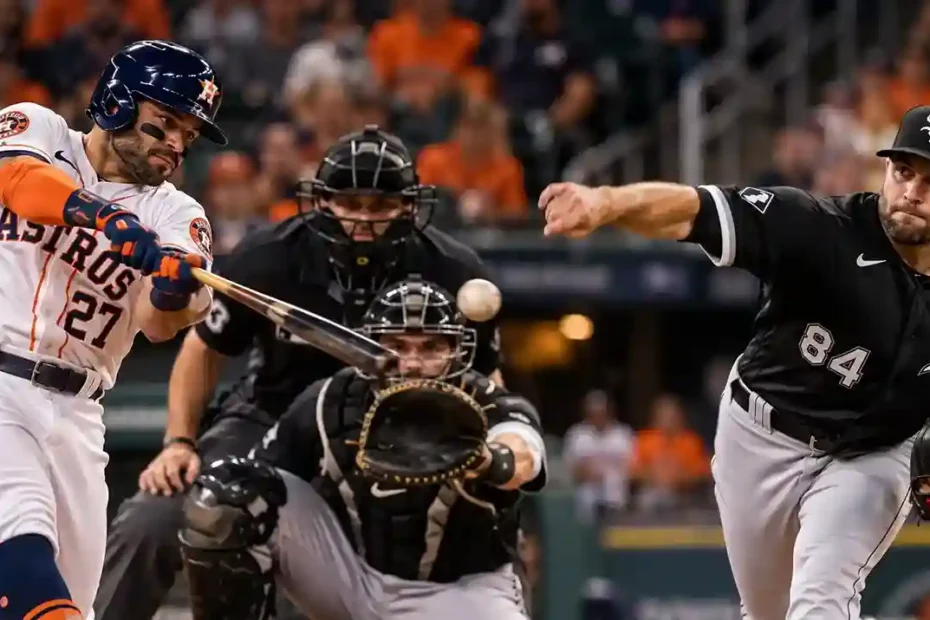
Most fans glance at the final score and move on. That is a mistake, because the real story of any game sits inside the box score. The Houston Astros vs Chicago White Sox match player stats from the 2026 season show exactly why: one lopsided slugfest, two tight pitching duels and a bullpen-decided comeback all happened inside seven games.
This guide walks through the latest numbers from every 2026 meeting, the players who drove the results, and the stat categories that actually explain who wins when these two clubs meet. You will know which hitters and pitchers to track before the next matchup.
Latest Updates: Houston Astros vs Chicago White Sox Match Player Stats in 2026
Here is what is new this season. The Astros and White Sox met seven times in 2026, in two separate series, and Houston came out on top with a 5-2 edge in the season series.
- July 24 to 26 at Chicago: Houston won the first two games, then the White Sox answered with a 12-3 blowout in the finale.
- August 31 to September 3 at Houston: The Astros won three of four games, including a 2-0 shutout and a 6-2 win in the finale.
- Standings context: After the September 3 finale, the White Sox stood at 73-67 and Houston at 72-69. Both clubs were leading their divisions at that point, so these games carried real weight.
If you are checking the most recent Astros vs White Sox match player stats before a bet, a fantasy lineup or a simple debate with friends, the sections below give you the individual numbers behind each result.
2026 Season Series at a Glance
| Date | Location | Final Score | Winner | Key Performers |
|---|---|---|---|---|
| July 24 | Chicago | Astros 9, White Sox 5 | Astros | Jeremy Peña 3-for-6, Jose Altuve 3-for-5, Christian Walker 3 RBI |
| July 25 | Chicago | Astros 4, White Sox 1 | Astros | Peña 3-for-4, Isaac Paredes 3 RBI |
| July 26 | Chicago | White Sox 12, Astros 3 | White Sox | Munetaka Murakami 2 HR, 6 RBI |
| August 31 | Houston | Astros 6, White Sox 3 | Astros | Astros opened the four-game set with a win |
| September 1 | Houston | White Sox 5, Astros 1 | White Sox | White Sox evened the series |
| September 2 | Houston | Astros 2, White Sox 0 | Astros | Nelson Velázquez 2-run single in the 8th |
| September 3 | Houston | Astros 6, White Sox 2 | Astros | Altuve 2-run HR, Daulton Varsho triple and 2 RBI |
The pattern is clear. Houston won through timely hitting and late-inning execution, while Chicago’s two wins came from pure offensive explosions and a strong starting performance.
Houston Astros Player Stats That Shaped the Series
Houston’s lineup is built on a mix of veteran contact hitters and a true middle-of-the-order power bat. When you read the Houston Astros vs Chicago White Sox match player stats for the Astros side, these are the names that matter.
Yordan Alvarez: The Power Anchor
Alvarez remains the most dangerous hitter in the Astros lineup. Heading into the August 31 opener, he led Houston with 37 home runs and a .607 slugging percentage, numbers that place him among the most productive sluggers in the league this season.
His box-score lines against Chicago were quieter than his season totals. He drew walks in several games, which tells you something important: White Sox pitchers were working around him rather than challenging him. A walk in the box score is often a sign of respect, and it kept traffic on the bases for hitters behind him such as Altuve and Paredes.
On September 2, Alvarez went 2-for-4 in the 2-0 win, one of the few games where he supplied the bulk of the offense himself.
Jose Altuve: Veteran Production in Key Moments
Altuve delivered some of the most impactful individual lines of the season series. He collected three hits in the July 24 win and then closed the final game of the year’s series with a two-run homer in the 6-2 victory on September 3.
His three RBI across those two games shows why Altuve still matters in high-leverage spots. In the context of Astros vs White Sox match player stats, he is the player whose timing has been most reliable.
Jeremy Peña: Leadoff Consistency
Peña quietly produced some of the best raw hit totals in the series. He went 3-for-6 on July 24 and followed it with a 3-for-4 night on July 25, reaching base consistently at the top of the order.
That matters because it gave the heart of the order more chances with runners on. When the leadoff man is getting on base at that rate, every other number in the lineup improves.
Isaac Paredes, Christian Walker and Daulton Varsho
Depth hitters decided several games. Paredes drove in three runs on July 25 and scored twice on September 3. Walker drove in three runs in the July 24 win and added two hits in the September 3 finale. Varsho closed the series with a triple and two RBI.
These are not the names that appear in headlines, but they are the reason Houston’s offense kept producing even when the top of the order went quiet.
Houston Pitching: Blanco, Brown and the Bullpen
The pitching side of the Houston Astros vs Chicago White Sox match player stats is more mixed. Ronel Blanco had a rough outing on July 26, allowing five earned runs and two home runs over 5.1 innings in the 12-3 loss. Hunter Brown, by contrast, entered the September 3 start with a 4-3 record, a 3.33 ERA and 86 strikeouts.
The most telling team-level pitching stat was about home runs. At the time of the final series, Houston was 32-7 in games where it did not allow a home run and only 37-61 when it gave up at least one. For Astros pitchers, preventing the long ball is the single biggest predictor of results.
Chicago White Sox Player Stats Worth Tracking
Chicago has reshaped its roster, and a new group of names now drives the offense. The Chicago White Sox side of the match player stats shows a lineup that is dangerous when it connects, even if it is less consistent than Houston’s.
Munetaka Murakami: The Breakout Power Threat
No single performance in the season series compares to Murakami’s July 26 game. He went 3-for-5 with two home runs and six RBI, a 1.800 slugging percentage for the day, in Chicago’s 12-3 win. It was the defining individual line of the entire series.
Outside of that game, Murakami was held in check. He finished 0-for-4 with three strikeouts on September 3, a reminder that he can be neutralized when Houston’s pitchers stay out of the middle of the zone.
Sam Antonacci, Miguel Vargas and Chase Meidroth
Antonacci set the table at the top of the order, collecting two hits on July 24 and two more on July 26. Vargas added a home run in the July 26 blowout and two hits on September 3. Meidroth also homered on July 26 and had two hits on September 3.
This trio gives Chicago a lineup with more depth than the old “one or two stars” profile. The White Sox were also the seventh-best slugging team in MLB at .409 entering the final series, which backs up what the individual lines show.
Andrew Benintendi and Colson Montgomery
Benintendi’s box-score lines were modest against Houston, including a 0-for-3 night on September 3, but his plate discipline still matters. He worked walks and pushed pitch counts. Colson Montgomery, meanwhile, had a quiet series at the plate, going hitless in both September 2 and September 3.
Chicago Pitching: Burke, Martin and the Late Innings
Sean Burke has been the most reliable name on the Chicago staff. Through the start of September he was 7-6 with a 3.32 ERA and 161 strikeouts. Davis Martin also delivered a strong outing on September 2, allowing no earned runs over 5.2 innings before the bullpen gave up the go-ahead runs in the eighth.
That game shows the core weakness in Chicago’s profile. The starters can keep the White Sox in a game, but the late innings have been less stable than Houston’s.
What the Numbers Say About Home Runs, Hits and Late-Game Execution
Reading the Houston Astros vs Chicago White Sox match player stats at the team level reveals three repeating themes.
The Home Run Factor
Both lineups hit for power. Before the July 25 game, Houston ranked third in the majors with 143 home runs while Chicago ranked ninth with 131. Yet the results in the head-to-head games were less about who hit more homers and more about who allowed them. Chicago’s July 26 win featured five White Sox homers, while Houston’s wins came through doubles, singles and situational hitting.
Hits Win Games for Chicago
One of the cleanest stats on the White Sox side: they were 49-25 in games in which they recorded at least eight hits. When Chicago’s hitters put the ball in play and string together base runners, the team is very difficult to beat. When the offense goes quiet, as it did in the 2-0 and 4-1 losses, the margin for error disappears.
Late Innings Decided the Close Games
Three of Houston’s wins in the series were decided by a late rally. The Astros scored eight runs in the sixth inning on July 24, three in the sixth on July 25, and two in the eighth on September 2 to break a scoreless tie. A well-timed bullpen and a lineup that keeps competing through the seventh and eighth innings have been the clearest separators.
Home and Road Splits in This Matchup
Venue matters in how you interpret any Astros vs White Sox match player stats report. Houston plays at Daikin Park, while Chicago plays at Rate Field.
The home and road records below the surface show a more balanced picture than you might expect. Entering the final series, Houston was just 35-36 at home, while Chicago was 32-39 on the road. Chicago’s road struggles were a clear weakness, and Houston won three of four in the most recent meeting at home. Earlier in the season, however, the White Sox were 31-18 at home before the July series, which shows how different their profile looks at Rate Field.
For anyone reading box scores, this is a reminder to always separate home and road data before drawing conclusions about a single player’s performance.
Advanced Stats to Watch in Future Matchups
Traditional numbers such as batting average and ERA tell only part of the story. To get the most out of the Houston Astros vs Chicago White Sox match player stats, add these to your routine.
Slugging Percentage and OPS
Slugging separates one-hit singles from real damage. Alvarez’s .607 slugging and Murakami’s 1.800 slugging on July 26 show how quickly a single game can swing on power alone.
Hard-Hit Rate and Barrel Rate
These tell you how often a hitter is squaring the ball up. A player with a high barrel rate but a low batting average is often due for a positive correction.
Strikeout and Walk Rates
Houston’s hitters struck out 12 times in the July 25 win and still won, which highlights how much timely hitting can matter. Chicago’s hitters struck out ten times on September 3. Tracking strikeout-to-walk trends tells you which side is controlling the zone.
Win Probability and Leverage
Late-game leverage stats explain why a single-run inning can matter more than a five-run blowout. Those are the innings that decided the series.
How to Read Astros vs White Sox Match Player Stats Like a Pro
If you want to use this data well, follow a simple process.
- Start with the pitching matchup. Starters such as Brown and Burke set the tone for how many runs each side can expect.
- Check recent hitter form. Look at each lineup’s last seven to ten games, not just the season average.
- Compare the bullpens. Late-inning performance has been the main tiebreaker in the recent head-to-head games.
- Adjust for venue. Separate Daikin Park and Rate Field numbers.
- Watch for lineup changes. Both teams used multiple outfield and infield combinations in 2026, so a box score from July may not match a September lineup.
Following these five steps will give you a clearer read than any single stat line.
Final Verdict: What the 2026 Match Player Stats Tell Us
The 2026 Houston Astros vs Chicago White Sox match player stats point to a clear conclusion. Houston’s edge came from lineup depth, timely hitting and the ability to win close games late. Chicago’s best moments came from power surges, led by Murakami’s huge July 26 game, and from solid starting pitching from Burke and Martin.
With both teams fighting at the top of their divisions, every new set of Astros vs White Sox match player stats carries more weight than a normal interleague meeting. Keep an eye on Alvarez’s power production, Altuve’s clutch at-bats, Murakami’s ability to punish mistakes and each bullpen’s late-inning consistency. Those four factors explain most of what happened in 2026 and are the best guide to what happens next.